Workflow Orchestration Tools: Build or Buy Guide
Learn how workflow orchestration tools unify AI agents and internal systems. Compare build vs buy, governance patterns, and ROI for ops leaders.
Most advice about workflow orchestration tools starts in the wrong place. It tells you to compare connectors, visual builders, deployment models, and AI features before asking whether the process deserves orchestration at all. That approach produces impressive demos and fragile production systems.
Founder-led teams don't need another automation layer that nobody owns. They need a controlled operating surface for custom software, integrations, approvals, and AI agents, with clear economics and a recovery plan when something fails.
Table of Contents
- Why Most Orchestration Projects Fail Before They Start
- What Workflow Orchestration Tools Actually Do
- Performance Levers That Separate Tools From Platforms
- The Governance Gap - Why Tool Proliferation Fails
- Build vs Buy - Economic and Operational Decision Framework
- Integration Patterns and Cost Measurement for LLM Workflows
- Migration Checklist and Next Steps for Founder-Led Teams
Why Most Orchestration Projects Fail Before They Start
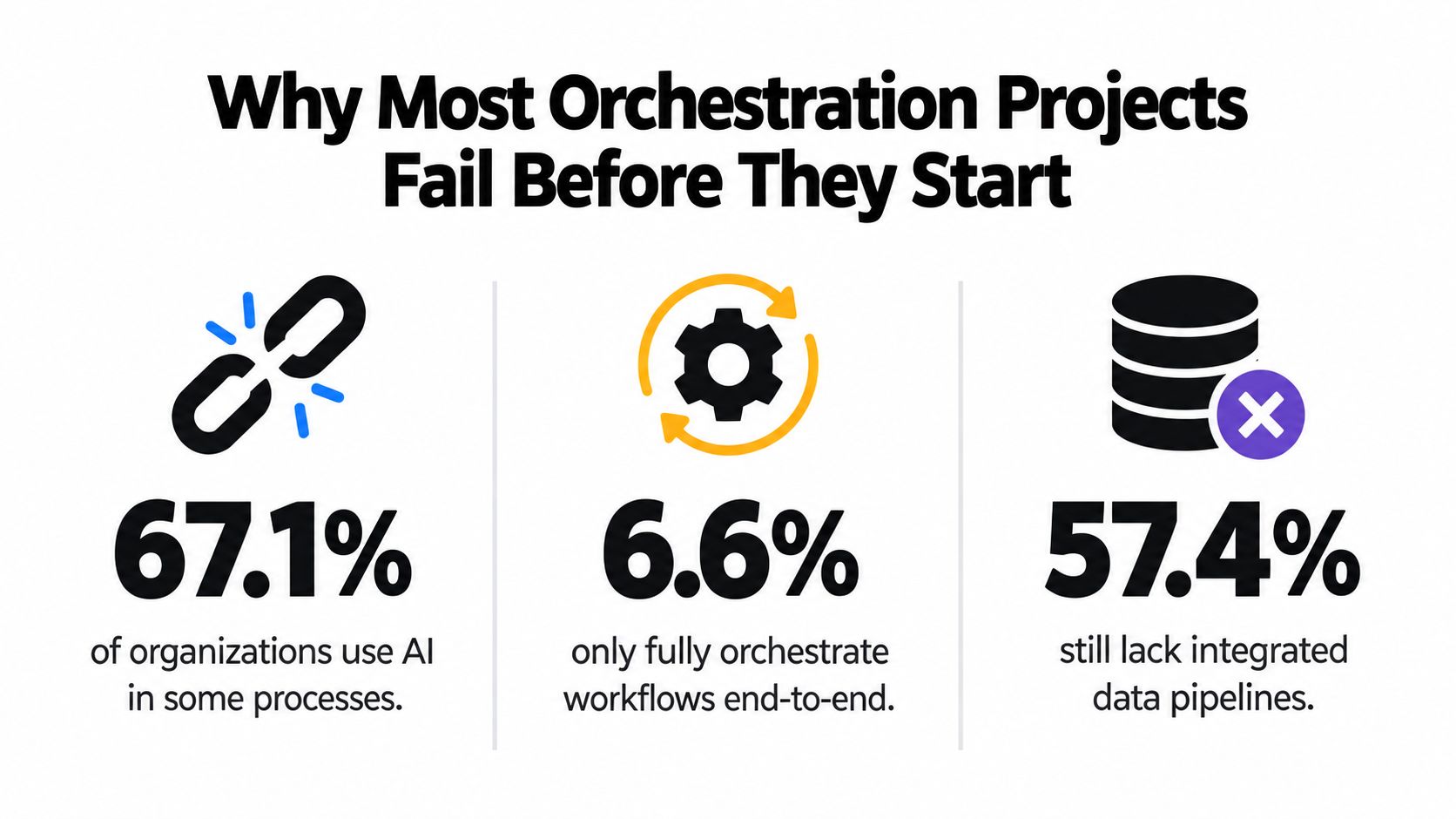
Orchestration fails before implementation when teams treat tool selection as the decision. A 2026 survey found that 67.1% of respondents used AI in at least some processes, but only 6.6% had fully orchestrated workflows end to end, while 57.4% still viewed humans as orchestrators and validators (Channel Insider's survey coverage).
The gap reflects governance and ownership decisions made before platform selection. Teams buy workflow orchestration tools without defining which actions require deterministic rules, which decisions need human approval, or who owns recovery when an external API, model, or internal service fails. The tool then formalizes an ungoverned process while concealing its complexity behind retries, dashboards, and configuration.
Start with the decision, not the platform
Before comparing workflow orchestration tools, answer four questions:
- Does the process need coordination? A single, stable API call likely needs a well-built service rather than a workflow platform.
- Does the process have meaningful state? If later actions depend on earlier results, approvals, or retries, orchestration has a clear operational role.
- Can the business define failure ownership? A failed lead-enrichment step needs a named operator, an alert route, and a recovery action.
- Is the outcome reversible? A draft summary is easier to automate than a reserve change, financial transfer, or external customer decision.
Automate preparation around a decision while keeping high-impact decisions human. An AI agent can classify a claim, collect supporting documents, identify missing information, and route the case to the right reviewer. It should not change reserves or send an external decision unless the authorization boundary explicitly permits that action.
Practical rule: Automate preparation, routing, reconciliation, and evidence collection first. Preserve human checkpoints where an incorrect decision carries a high cost.
Founders should also test whether orchestration is covering up a process redesign problem. Contradictory rules, inconsistent data, and absent ownership will remain unreliable after adding retries and dashboards. Fix the operating decision first, then choose the smallest custom software architecture that can enforce it.
What Workflow Orchestration Tools Actually Do
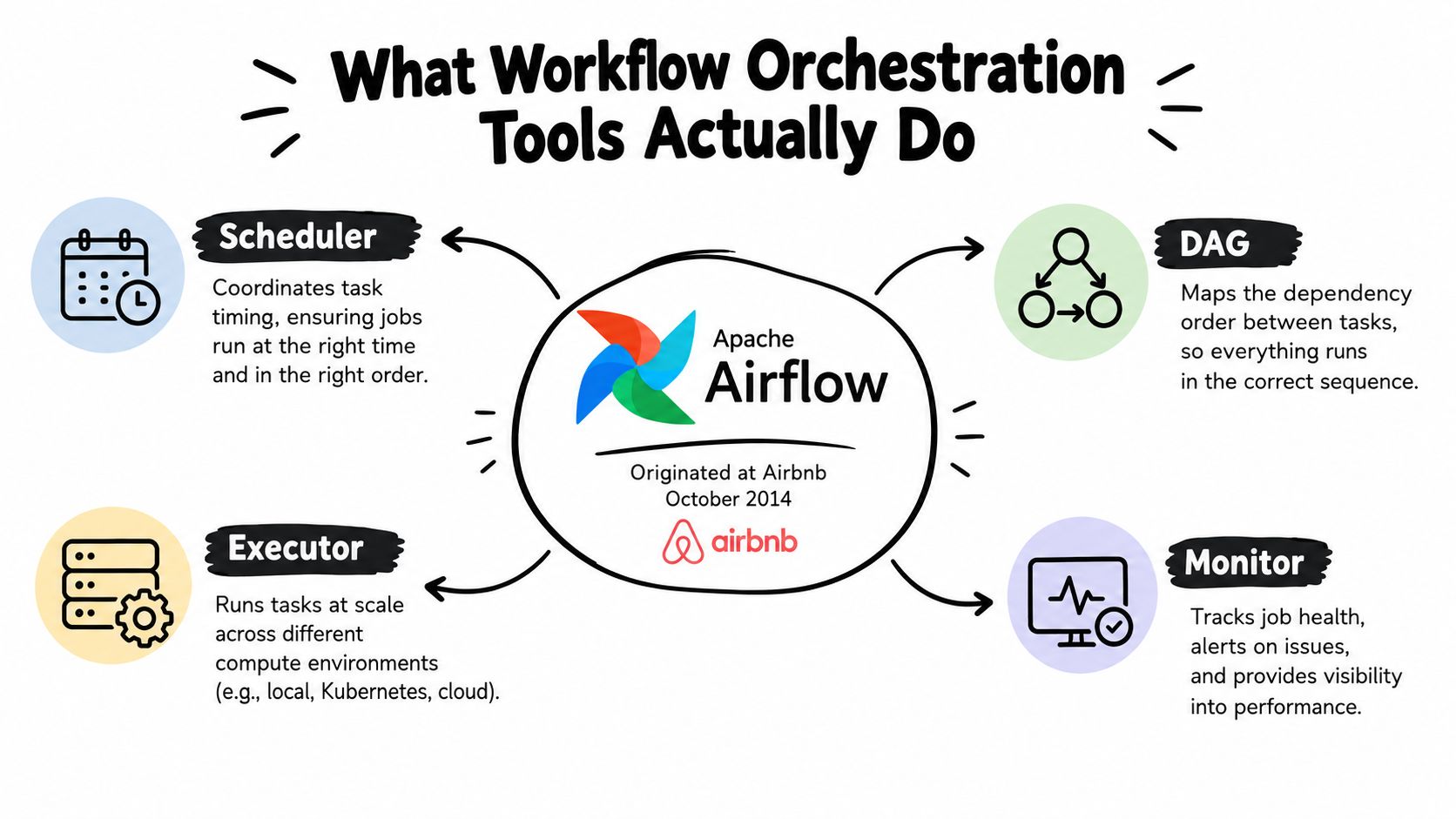
Workflow automation performs an action. Workflow orchestration manages the process around that action, including sequence, dependencies, state, retries, monitoring, and ownership.
Apache Airflow provides a useful architectural milestone. Airbnb created it in October 2014 to schedule and coordinate data-engineering workflows, open-sourced it in June 2015, and it entered the Apache Incubator in March 2016 before graduating as an Apache Top-Level Project in January 2019 (Apache Airflow history). Its importance wasn't just the calendar scheduler. Airflow made dependencies explicit through directed acyclic graphs, or DAGs.
DAGs turn hidden process logic into an operating model
In a DAG, each task is a node. Dependencies define the execution order, while the orchestration engine decides when a task can run, what happens after failure, and how operators inspect the result.
Consider a custom client-risk workflow:
- Retrieve account and engagement data from internal systems.
- Extract risk signals from documents with an LLM.
- Score the account using deterministic business rules.
- Ask a reviewer to approve an escalation.
- Write the outcome back to the system of record.
- Notify the responsible team.
A basic automation might trigger each step with disconnected scripts. An orchestrated workflow preserves state across the sequence, records the model output, waits for approval, retries temporary integration failures, and routes exceptions to a named owner.
That distinction matters because orchestration isn't just scheduling. It coordinates databases, APIs, custom applications, AI services, and human approvals under a managed layer. The system needs to know what has completed, what is blocked, what can safely be retried, and what requires intervention.
Choose the runtime around the workflow shape
Kubernetes demonstrates how broadly managed coordination has become an operational expectation. In a 2024 Linux Foundation Research survey of Kubernetes users, 646 completed responses were collected from an initial 715 participants. 77% said Kubernetes was very or extremely important to their business, 76% planned to increase adoption, and 90% reported improvements to software-development processes (Linux Foundation Research survey).
Kubernetes isn't a general-purpose business workflow engine. It orchestrates containers rather than approvals and customer decisions. The relevant lesson is architectural: reliable coordination needs standardized execution, observability, recovery, and ownership. For custom AI software, keep the deterministic workflow state separate from probabilistic model inference. A model can produce an uncertain answer, but it shouldn't be allowed to corrupt the process state or bypass an approval gate.
Performance Levers That Separate Tools From Platforms
An orchestration platform can make a workflow faster, slower, or more expensive. The result depends on workload shape, not on whether the product advertises parallel execution.
A controlled DAG-based machine-learning experiment found that parallel orchestration performed worse for light workloads, with a 0.71 speedup relative to sequential execution. For heavy workloads, average makespan fell from 1,013 seconds to 532 seconds, producing a 1.90× speedup, while model-quality metrics such as RMSE and R² didn't materially change (DAG parallel orchestration experiment).
The lesson is simple. Don't distribute short API calls, small database updates, or trivial transformations across workers unless the work is large enough to absorb queueing, serialization, worker startup, retries, and result aggregation.
Measure the critical path
Scheduling policy is another production lever. A benchmark of 150 real-world workflow instances containing as many as 1,695 tasks evaluated 16 scheduling algorithms across 10 multi-core cluster configurations (workflow scheduling benchmark). The result supports a practical position: scheduling choices can separate performance across schedule length, resource utilization, and workload characteristics.
Expose these metrics before adding workers:
- Queue time, to show whether tasks are waiting for capacity.
- Critical-path duration, to identify the dependency chain that controls completion.
- Worker utilization, to distinguish contention from inefficient task design.
- Retry counts, to reveal unstable integrations or unsafe idempotency.
- Deadline compliance, to connect technical performance with an operating commitment.
A real-time lead-scoring workflow, for example, shouldn't use the same policy as a nightly document-classification job. Teams designing real-time lead scoring systems should keep interactive paths short, observable, and resistant to queue buildup.
Treat LLM batching as a product decision
LLM workflows add another constraint. Research on Sarathi-Serve found that naive hybrid batching could increase time-between-tokens latency by as much as 28.3× compared with decode-only batching (Sarathi-Serve batching research). A batch that improves throughput can make an analyst-facing response feel broken.
Separate interactive requests from background work. Route an urgent case summary to a low-queue path, while batching nightly classification or portfolio updates. Record queue time, first-token latency, time-between-token latency, and completion time. Release a partial batch when its maximum wait threshold is reached.
| Workload Characteristic | Parallel Execution | Dynamic Batching | Sequential Processing |
|---|---|---|---|
| Short API calls and small transformations | Usually adds coordination drag | Useful only at meaningful volume | Often the simplest and fastest choice |
| Long-running analysis or document processing | Can reduce makespan when tasks are substantial | Suitable for deadline-tolerant background work | May leave available capacity unused |
| Interactive LLM decisions | Use selectively, with strict queue monitoring | Cap batch size and wait time | Appropriate when response priority is high |
| Large recurring ML pipelines | Use after end-to-end benchmarking | Tune around input and output patterns | Useful as a baseline for comparison |
The Governance Gap - Why Tool Proliferation Fails
Tool proliferation becomes expensive when permissions, approvals, and escalation paths remain implicit. A separate 2026 automation report found that 89% of organizations manage multiple automation platforms, but only 49% had fully integrated managed-file-transfer workflows (automation platform governance findings). The gap is a governance problem expressed through architecture.
One team may configure CRM automation, another may operate the AI service, and a third may maintain the internal application receiving its output. Those boundaries matter because each system can execute a different part of the process. The orchestration layer must define who can authorize an action, which evidence supports it, and where an exception goes.
Give agents bounded authority
Agentic AI needs controls that match its autonomy. The cited agentic AI risk profile recommends escalating safeguards by autonomy tier. Tier 2 requires documented action scope, delegated approval authority, and escalation triggers, while Tier 3 requires continuous behavioral monitoring, anomaly-response playbooks, and documented fail-safe conditions (agentic AI risk profile).
Use an internal claims-routing agent as the test case. It can classify incoming claims, assign queues, and identify missing documents. Human approval should remain mandatory before it changes reserves or sends an external decision.
The orchestration layer should record:
- Agent identity, including the version or deployment responsible for the action.
- Tool and requested action, so operators can reconstruct what the agent attempted.
- Authorization level and approver, including delegated approval boundaries.
- Outcome and evidence, including the final system update.
- Escalation reason, such as low confidence, policy conflict, or excessive delegation depth.
Make governance executable
A policy stored in a shared folder has no enforcement power during execution. Encode these five rules in the workflow:
- Mark deterministic steps. Use rules for eligibility, thresholds, permissions, and required fields.
- Assign human checkpoints. Specify which outputs require review and what happens when the reviewer does not respond.
- Restrict permissions by action. Reading policy documents does not grant permission to change customer records.
- Route exceptions to roles. Use named queues and escalation timers instead of a generic inbox.
- Assign failure ownership. One person or team must own the completed workflow, even when several systems participate.
Permissioning and escalation extend failure ownership into executable controls. Every agent action needs a boundary, an approver, and a recorded result. That is how governance keeps tool adoption from becoming uncontrolled operational complexity.
Build vs Buy - Economic and Operational Decision Framework
The build-versus-buy decision shouldn't begin with a product demo. It should begin with the workflow's economic profile and the cost of failure.
An MIT-related 2025 study reported that only about 5% of enterprise generative-AI pilots achieved rapid revenue acceleration, while most produced little measurable P&L impact (MIT-related enterprise AI study coverage). The same source cited research reporting that 42% of companies abandoned most AI initiatives in 2025, up from 17% in 2024. These findings don't prove that orchestration tools fail. They show why process ownership, data readiness, and production adoption matter more than selecting a fashionable platform.

Rank the workflow before choosing the architecture
Evaluate candidate workflows by these factors:
- Transaction volume: A high-volume process can justify engineering effort sooner, but only if the work is stable.
- Error cost: Prioritize processes where missed handoffs, duplicate work, or late decisions create material loss.
- Decision latency: Orchestration has more value when waiting on several systems or reviewers delays revenue or service.
- Exception frequency: Frequent exceptions may require a better process design rather than more automation.
- Data quality: Poor inputs make AI workflows expensive and unreliable.
- Reversibility: Start with actions that can be reviewed, corrected, or rolled back.
Calculate recurring labor and rework savings. Then subtract monitoring, retries, support, security review, model calls, integration maintenance, and handoffs. If the process has no clear owner or the source data needs constant manual repair, the right answer may be to redesign it or leave it alone.
Buy the runtime, build the business logic
Buy a managed orchestration runtime when your team needs durable execution, standard monitoring, permissions, and recovery but doesn't need a unique process model. Build custom software when your competitive advantage sits in the business rules, user experience, integration behavior, or decision workflow.
A small deterministic integration can outperform an ambitious AI workflow when the process is stable and rules are clear. Conversely, orchestration earns its keep when a business outcome crosses several systems, approvals, and failure-recovery paths. Repetitive work alone isn't enough.
For a practical comparison of the engineering and operating trade-offs, use this build-versus-buy framework for AI tooling before shortlisting vendors.
Integration Patterns and Cost Measurement for LLM Workflows
LLM cost belongs to the completed workflow, not the visible model response. A customer-risk assessment might retrieve records, extract facts from documents, score the account, generate an explanation, and prepare an approval summary. Counting only the final response hides the actual execution path.
Create an observable workflow envelope
Assign every workflow a correlation ID when it starts. Pass that ID through retrieval services, custom business logic, model calls, tool calls, retries, fallbacks, and approval steps.
Record at least:
- Input and output tokens for every model call.
- Number of model calls, including retries and fallback models.
- Tool-call count and duration, including external integrations.
- Cost per completed workflow, not only cost per request.
- Human overrides and failed outcomes, so cost can be compared with quality.
Test prompt reduction, semantic caching, model routing, batching, quantization, and KV-cache improvements against latency and quality requirements. Don't optimize token spend by creating slower reviews or weaker decisions.
A portfolio-monitoring agent illustrates the pattern. It can retrieve holdings, classify risk signals, draft a summary, and route exceptions to an analyst. A system such as a client portfolio agent should make each step traceable, so operations can identify whether cost comes from retrieval, repeated inference, tool failures, or unnecessary model use.
Separate agent reasoning from authority
The model may recommend an action, but the orchestration layer should decide whether that action is permitted. Log the agent, tool, requested action, authorization level, approver, and outcome. Block actions outside the declared scope, and escalate when confidence, policy conditions, or delegation depth crosses a configured threshold.
Keep the integration pattern deliberately boring:
- Trigger from an event, scheduled job, or approved user request.
- Retrieve only the data required for the current step.
- Reason with the appropriate model and a constrained tool set.
- Validate against deterministic rules.
- Approve when the decision carries material risk.
- Commit the update to the system of record.
- Record evidence, cost, and outcome under the correlation ID.
This structure lets a team replace a model without rewriting the business process. It also prevents a successful model response from being mistaken for a successfully completed workflow.
Migration Checklist and Next Steps for Founder-Led Teams
Start with an operational inventory, not a platform shortlist. Audit recurring manual processes, spreadsheet workflows, custom applications, approval queues, and AI experiments. Identify three highest-ROI builds and one workflow to avoid.
Then establish governance tiers and place human checkpoints before selecting software. Choose orchestration tools based on integration depth, state management, permissions, recovery, and observability, not feature-count comparisons.
Use this sequence:
- Map the current process. Record systems, owners, handoffs, exceptions, and irreversible actions.
- Rank the economics. Include labor, rework, support, security review, model usage, and failure costs.
- Benchmark the baseline. Measure end-to-end makespan before distributing work across workers.
- Instrument LLM workflows. Add correlation IDs and capture token usage and cost for every model and tool call.
- Pilot safely. Start with a low-risk workflow that has a clear owner and reversible outcomes.
- Scale by evidence. Expand only after operators can monitor, recover, and independently change the system.
Founder-led firms in the $500K to $20M revenue range should prioritize clarity over complexity. Use fixed-price scoping when the workflow is defined, and paid discovery when the process, data, or ownership is still unclear.
Orchestration succeeds when it creates one working surface, reduces context switching, and gives operational teams independent control of their systems.
Internal Systems designs custom software, integrations, monitored orchestration, and AI-enabled workflows for operational teams that need reliable handoffs and human checkpoints. Visit Internal Systems to identify the highest-ROI workflow to build and choose a delivery path based on the clarity of your scope.