What Is Operational Audit
What is operational audit. Learn what an operational audit is, how it differs from financial and compliance audits, and how a 1–2 week audit drives ROI-ranked
You know the problem already. Cases sit in one system, approvals live in inboxes, and your team keeps patching gaps with copy-paste, Slack pings, and tribal knowledge. The work gets done, but it gets done the hard way, and every new tool you add makes the handoffs more fragile.
A what is operational audit question gets answered best by looking at the work, not the slide deck. An operational audit is a systematic, objective review of how a function, process, or workflow performs against the 4Es, economy, efficiency, effectiveness, and ethics, with findings grounded in evidence and followed by prioritized recommendations. It's the diagnostic step before you commission custom software or AI, because you shouldn't automate a broken workflow you haven't mapped.
If you want a practical reference point for how disciplined workflow improvement gets translated into engineering choices, the DevOps operational excellence playbook is a useful companion read. It lines up with the same basic truth, fix the system first, then build on it.
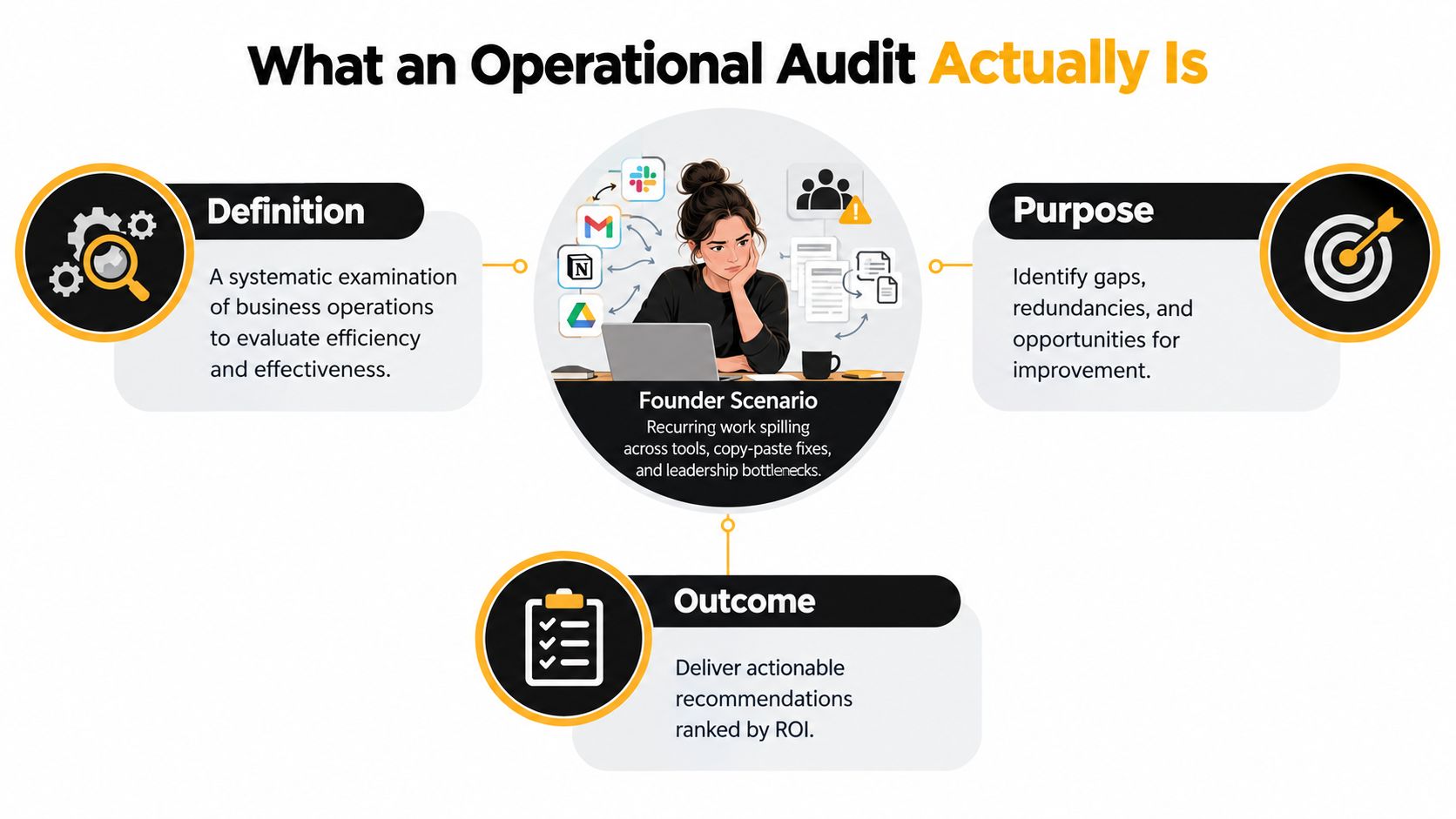
Table of Contents
- What an Operational Audit Is
- Operational Audit vs Financial and Compliance Audits
- A Realistic 1 to 2 Week Audit Process
- From Findings to an ROI Ranked Build Plan
- Auditing AI Enabled and Automated Workflows
- How to Prepare and What Outcomes to Expect
- Next Steps and Choosing the Right Audit Partner
What an Operational Audit Is
An operational audit is a structured examination of live operations, and it has nothing to do with judging your team's effort. It checks whether resources are acquired at the right cost, used with minimal waste, and turned into the intended results, which is why the three Es framework, economy, efficiency, and effectiveness, still matters in practice IIA operational auditing factsheet. The Institute of Internal Auditors describes internal auditing as an independent, objective assurance and advisory activity that improves operations through a disciplined approach to governance, risk, and control, and operational auditing is the part of that discipline that looks at how work flows IIA training reference.
What it looks at in a real business
In a founder-led company, the pain usually shows up as recurring manual transfers, duplicate data entry, approval bottlenecks, and a leadership team answering the same questions over and over. An operational audit maps the end-to-end workflow, tests the control points, and tells you where the friction comes from, whether that's procurement, order-to-cash, claims handling, staffing, service delivery, technology controls, or cross-functional handoffs.
Practical rule: if your team can't explain how work moves from trigger to resolution without pointing at five different tools, you need an operational audit before you touch software.
A generic process review stops at observations. A real operational audit goes further: it produces evidence-based findings, control weaknesses, duplicated work, bottlenecks, risks, and improvement opportunities, then converts them into prioritized recommendations. It tells you what to build, what to fix, and what to stop.
For teams that have outgrown spreadsheets but aren't ready to rebuild core systems blind, that distinction is everything. The audit establishes how work happens before anyone writes a spec, scopes an automation, or wires AI into a broken handoff. Skip it and you end up digitizing confusion. The same principle holds in engineering organizations, and the DevOps operational excellence playbook shows how disciplined workflow improvement translates into concrete engineering choices. Fix the system first, then build on it.
Operational Audit vs Financial and Compliance Audits
Choose the audit based on the decision you need to make. Financial audits assess whether statements are fairly presented. Compliance audits test adherence to laws, policies, or standards. Operational audits examine how work runs and identify what management should change.
Comparing audit types at a glance
| Audit type | Primary question | Typical scope | Output | Who acts on it |
|---|---|---|---|---|
| Financial audit | Are the financial statements fairly presented? | Ledger accuracy, disclosures, reporting controls | Opinion on reporting fairness | Finance leadership, investors, lenders |
| Compliance audit | Are we following laws, policies, or standards? | Legal and policy adherence, control evidence | Findings tied to requirements | Legal, compliance, risk owners |
| Operational audit | Does this workflow run economically, efficiently, and effectively? | End-to-end process flow, controls, handoffs, systems | Evidence-based findings and ranked recommendations | Operations leaders, product, engineering, automation teams |
Operational auditing examines the risk-and-control layer behind day-to-day execution. The GAO's internal control model identifies five components: control environment, risk assessment, control activities, information and communication, and monitoring. It defines internal control as a process that provides reasonable assurance, rather than absolute certainty, that objectives will be achieved GAO Green Book.
That distinction changes the deliverable. A financial audit can confirm that the books are reliable. A compliance audit can identify exposure to penalties or failed requirements. An operational audit tests whether approval logic, routing rules, exception handling, data movement, and system handoffs support the business in practice.
For a company considering custom software or an AI workflow, the operational audit should come first. It ranks the problems by business return and sets the build sequence: correct the process, automate stable work, then apply AI where judgment or volume justifies it. Otherwise, the team risks encoding unnecessary steps and weak controls into a new system.
Decision cue: choose financial for reporting accuracy, compliance for regulatory exposure, and operational for workflow performance, automation design, or a ranked improvement and build plan.
A Realistic 1 to 2 Week Audit Process
A good operational audit is short, focused, and grounded in evidence. It's not a months-long theater production, it's a fixed-scope engagement that forces clarity fast, then gives you a deliverable you can use to decide what to build next.
What happens during the week
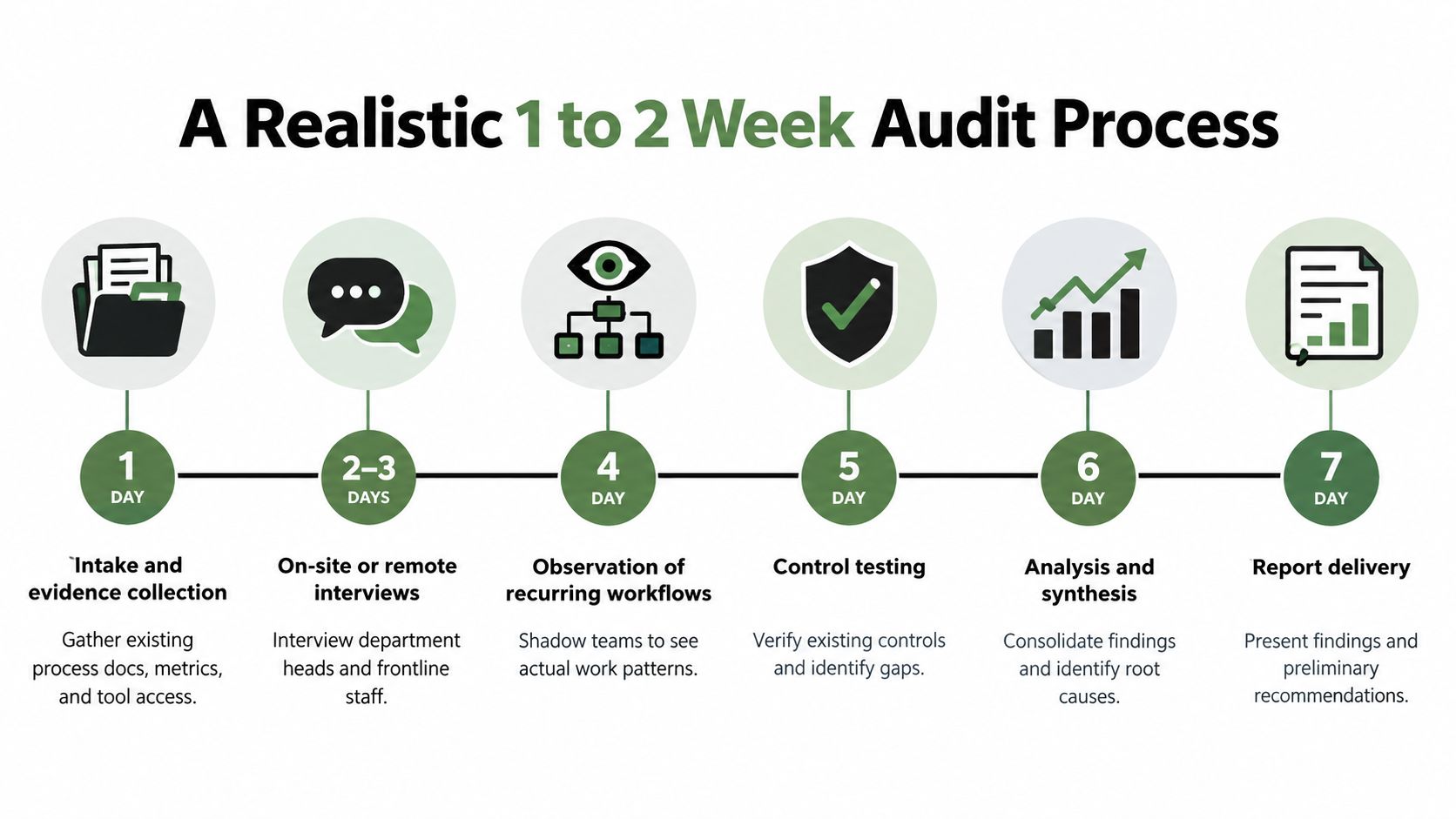
Day 1 starts with intake and evidence collection. The team gathers process docs, current reports, tool access, and whatever already exists to show how the workflow is supposed to run. The artifact at this stage is a source pack, not a slide deck, because you need the raw material before you can judge the system.
Day 2 and Day 3 are for interviews. Department heads explain the intended process, frontline staff explain what really happens, and the gap between those two answers usually tells you where the actual issue is. That produces an interview log, a process map draft, and a list of open questions.
Day 4 is observation. You shadow the work, watch the exceptions, and note where people are compensating for weak tooling or unclear logic. That's the difference between a policy review and an operational audit, you're watching behavior, not just reading documentation.
Day 5 is control testing. The team checks whether approvals, validations, access rights, and exception paths work as intended. The output here is a test sheet with pass/fail evidence, plus notes on where the workflow breaks down.
Day 6 is analysis and synthesis. Findings get grouped by root cause, risk, and effort to fix. Day 7 is the delivery of the findings document, which should include the baseline, the evidence, and preliminary recommendations, not just a summary of complaints.
If you want a concrete example of how this kind of work becomes a productized internal workflow, the insurance operations dashboard project shows the sort of operational surface area this process is meant to uncover.
The point of the timeline is discipline. If a provider can't produce evidence quickly, stay skeptical. A real audit should leave you with clarity in days, not a vague promise that someone will “circle back” with a deck.
From Findings to an ROI Ranked Build Plan
The build plan, not the report, is where the value of an operational audit lives. A strong audit should leave you with a ranked list of fixes, a clear view of how those changes fit together, and a sequence that respects dependencies so the team is not trying to ship six partial fixes at once.
Turn one finding into a usable decision
Take a customer onboarding workflow. The audit finds missing required-field validation. The right output is a decision package, baseline metric, root cause, risk exposure, recommended intervention, owner, and target measure.
That finding should look like this in practice:
- Baseline: onboarding records arrive incomplete.
- Root cause: the intake form allows submission without key fields.
- Risk exposure: downstream correction work and inconsistent records.
- Recommended intervention: enforce validation at submission and add exception routing.
- Owner: operations or product.
- Target measure: fewer incomplete submissions and less manual rework.
Now rank that intervention alongside every other finding by risk reduction, implementation effort, and expected operating benefit. That ranking beats a generic roadmap. It puts engineering time behind the fixes that remove the most friction, instead of the ones that are easiest to describe in a meeting.
Build the sequence, not just the backlog
A good audit output also gives you the order of work. Validation may need to come before case routing, because routing logic will not rescue bad source data. Reporting may need to wait until the system records the right events. That dependency map is the difference between an architecture document and a wish list.
Operational rule: start with the fix that removes the most recurring manual correction, then sequence the rest around it.
Custom software work gets sharper here. The audit tells you which workflow deserves a build, which one should be automated, and which one should wait. If you are planning a 60 to 90 plus day build cycle, this sequence keeps the team from locking in the wrong architecture.
Auditing AI Enabled and Automated Workflows
AI changes the audit surface, but it doesn't change the logic. If a custom LLM classifies cases, routes them to the right queue, and summarizes them for review, the operational question is no longer just whether the model works. It's whether the full workflow behaves safely, consistently, and with the right human oversight.
What to test when AI is in the loop
A practical AI-focused audit asks simple questions. What decisions does the system influence? What data and permissions does it use? Where can errors, bias, hallucinations, privacy leakage, or silent failure happen? Who reviews exceptions, and is there an audit trail? That's the right lens because AI efficiency can look good on paper while the workflow gets worse in practice.
NIST's AI Risk Management Framework says organizations should define and document human oversight, with roles and responsibilities differentiated inside human-AI configurations, and it recommends monitoring and documenting cases where humans override AI decisions NIST AI RMF. In a production workflow, that means you should retain the model version, input, recommendation, approving employee, override reason, and final outcome. If the system can't explain who overruled what, you don't have control, you have a black box.
For automation-heavy teams, it's also smart to treat delivery performance as part of the same audit surface. DORA's software delivery metrics include change lead time, deployment frequency, failed-deployment recovery time, change-fail rate, and deployment rework rate DORA metrics history. If your AI workflow ships fast but breaks often, the operations team still loses.
The distinction is between bolting a chatbot onto an old process and redesigning the workflow around AI. McKinsey's 2025 survey found that 88% of organizations regularly use AI in at least one business function, up from 78% the previous year, while only 23% reported scaling an agentic AI system somewhere in the enterprise McKinsey 2025 AI survey. That gap is the whole story, many teams are adding AI features, far fewer are redesigning the operating model.
If you want a concrete example of how automation gets turned into an internal system, the real estate lead automation project shows the kind of routing and summarization logic that should be audited before scale.
For a practical automation reference, Truespeak's automation audit guide is useful because it reinforces the same rule, the workflow has to be measured where it runs, not where someone says it runs.
How to Prepare and What Outcomes to Expect
Come prepared with people, artifacts, and decisions, not polished slides. Bring the process owner, the actual users, sample data, a current tooling map, and a list of known pain points. That is enough to run a focused audit without wasting time on workshop theater.
Do not spend days building an internal report about the problem. The audit team should learn the system through evidence, interviews, and observation. Your job is to make the actual workflow visible, not to clean it up first.
What you should expect
A straightforward engagement usually takes 1 to 2 weeks when the scope is clear and the process is stable. If the scope is fuzzy, paid discovery comes first, before any build starts. That keeps you from guessing your way into a bad architecture.
The deliverables should be concrete. You want a ranked ROI list, an architecture document, and a recommended build sequence. Those three outputs tell you what to fix first, what to build, and what to delay.
Rule of thumb: if the workflow repeats often, crosses multiple handoffs, and still depends on manual correction, audit it first. If the process is already well understood and the build is small, you can sometimes go straight to implementation.
Internal Systems offers an Operations Audit as a fixed-price diagnostic, and that model fits teams that need a decision before a build.
Next Steps and Choosing the Right Audit Partner
Choose an audit partner the same way you would choose a builder. Look for the team that can turn ambiguity into a concrete sequence of work. Ask who stays on the engagement from start to finish, how findings are grounded in evidence, and whether the handoff includes the code, documentation, and operating notes your team needs to run it without help.
Skip the glossy report. A good audit should leave you with a buildable plan, because the point is to reduce uncertainty before engineering starts. That means the partner should be comfortable scoping AI-Powered Workflows or Operational Automation directly from the recommendations, not treating the report as the finish line.
A first call should answer a few hard questions:
- Senior continuity: Who leads the audit, and does that person stay with the work?
- Evidence standard: What counts as proof, interviews, logs, system traces, or observed workflow?
- Ownership at handoff: Who owns the code, documentation, and workflow design after delivery?
- Ranking method: How are findings prioritized by risk reduction, effort, and operating benefit?
- Build readiness: Can they turn the audit into an architecture document and a delivery sequence?
- AI coverage: If the workflow uses models or automation, do they test oversight, exception handling, and audit trails?
For teams deciding whether to buy tooling or build a custom system, this build-versus-buy AI tooling comparison is a useful filter. The right answer depends on how much process change you are willing to own.
If you are ready to stop patching a broken workflow, choose the audit that produces the decision, the ROI ranking, and the build sequence. That is the shortest path from operational mess to a system your team can run without constant intervention.