Webhooks vs WebSockets: A Guide for AI Software Teams
Compare webhooks vs WebSockets for custom software and AI workflows. Learn latency, cost, reliability, and when to use each in internal systems.
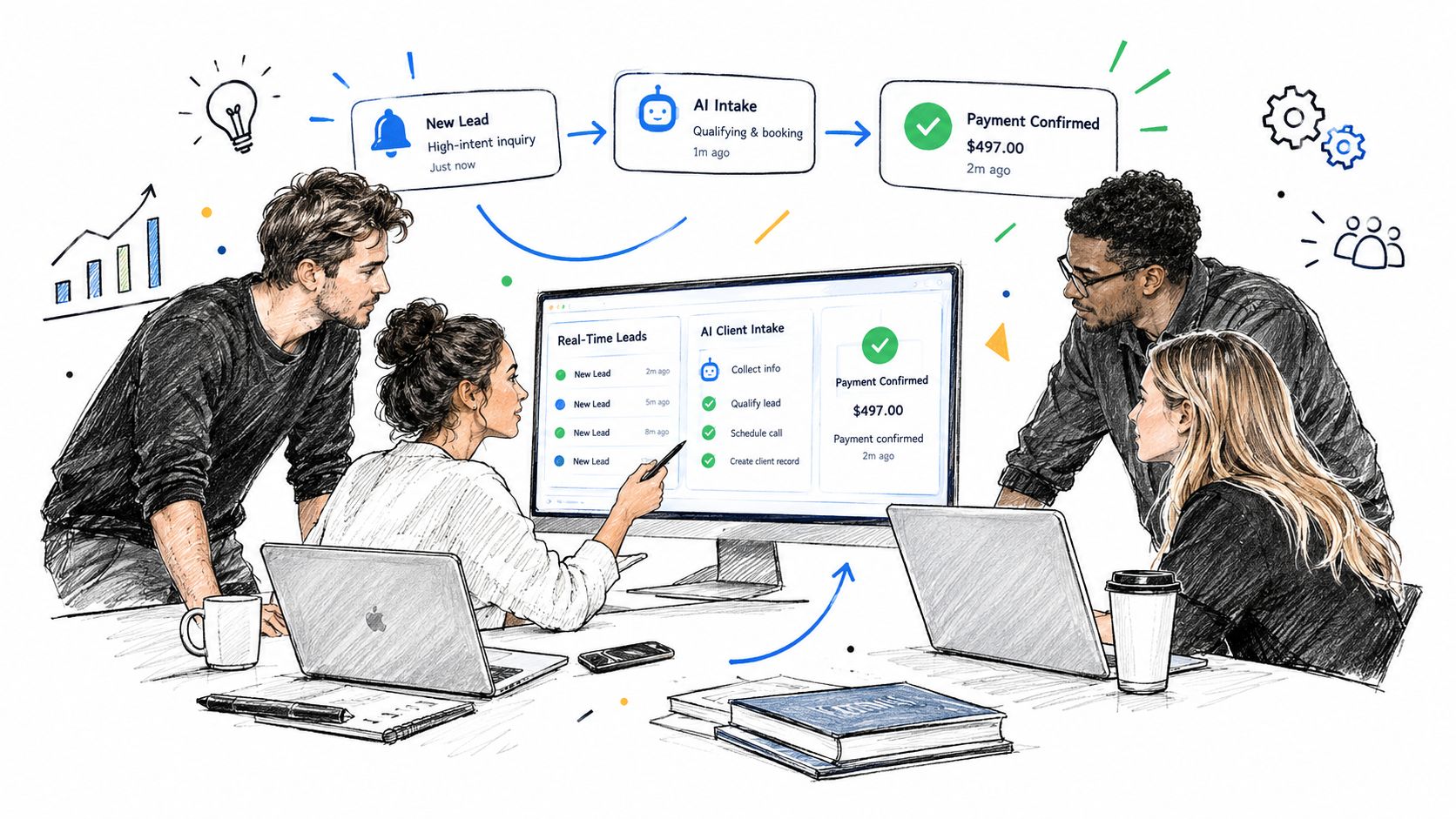
Your AI intake workflow is live. A lead arrives, an agent classifies it, a scoring service evaluates it, and an operations dashboard should show the result immediately. Then a payment confirmation arrives while the dashboard is offline, and the team discovers that the event was tied to a connection that no longer existed.
That's the practical problem behind webhooks vs WebSockets. The choice isn't just about speed or modernity. It's about deciding which operational failure your custom software can tolerate: a missed business event or a disrupted live session.
Table of Contents
- Why Protocol Choice Matters for Operational Teams
- Connection Models and Delivery Patterns
- Latency, Performance, and Cost Trade-offs
- Reliability, Security, and Failure Modes
- Hybrid Architecture and Decision Framework
- Implementation Checklist for Internal Systems
Why Protocol Choice Matters for Operational Teams
A founder-led operations team building an AI client intake system often needs both kinds of behavior. When a new lead arrives, staff may need immediate visibility so they can review the AI classification, correct a routing decision, or intervene before the lead goes cold. When a payment clears, a contract is signed, or an AI workflow completes, the system needs to capture that event even if nobody has the dashboard open.
A team that uses WebSockets for every integration can create a polished first version and an expensive operational problem later. The dashboard feels instant, but the backend now depends on connection lifecycle management, reconnection behavior, session state, and message recovery. A temporary browser closure or network interruption can become a missing workflow step unless the application adds its own durability layer.
Webhooks are event-driven HTTP callbacks. A source system sends a request to your endpoint when something happens, such as a successful payment, a changed order status, or an AI workflow completion, and the request ends. WebSockets create a persistent, bidirectional channel, allowing the browser and server to exchange messages continuously after the connection is established. The WebSocket protocol standard was formally published in December 2011, establishing the persistent connection model used by real-time web applications.
Practical rule: If the event changes the business record, capture it durably. If the event changes what a connected user sees right now, consider a live channel.
For custom software teams, the distinction affects architecture, staffing, monitoring, and incident response. A webhook receiver can accept an event while a user is offline. A WebSocket client can provide an excellent interactive experience, but the application must decide what happens when that client disconnects.
The wrong protocol often appears to work during development because developers keep the browser open, networks are stable, and event volume is low. Production operations expose the gap. A missed AI approval, duplicate automation, or abandoned connection creates work for people who thought the system had already handled it.
Connection Models and Delivery Patterns
WebSockets and webhooks solve different communication problems. Treating them as interchangeable creates unclear ownership of state and delivery.
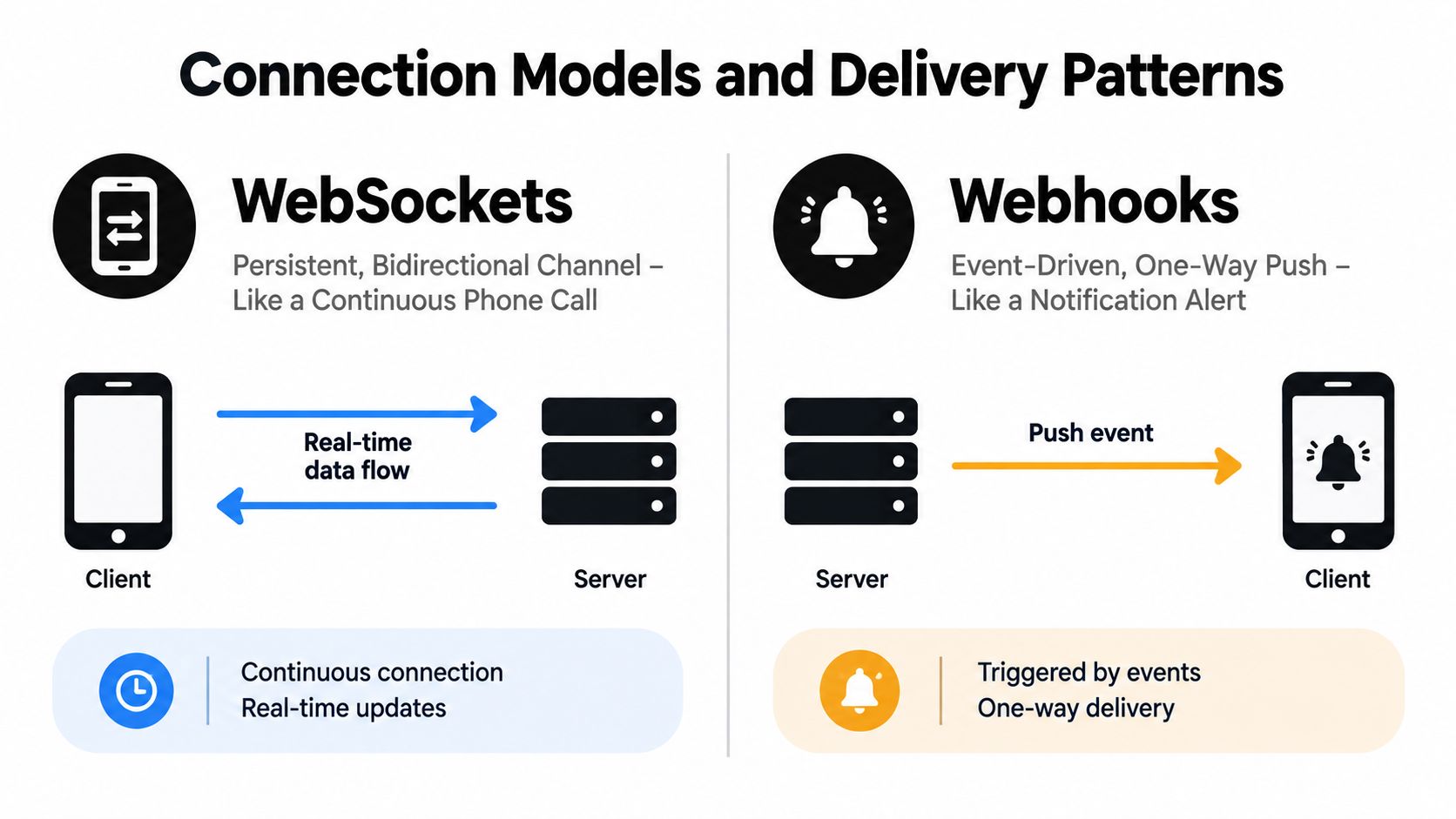
A WebSocket behaves like an ongoing conversation. The client opens a connection, the server accepts it, and both sides can send messages while the session remains active. That model suits an AI operations dashboard where a user watches an agent stream findings, changes a filter, approves a recommendation, and receives updated status without a separate request for every interaction.
A webhook behaves more like a notification. The source system sends an HTTP request to a receiver, the receiver acknowledges it, and the connection ends. The receiving application can process the event immediately or place it into a queue for later handling. This is a natural fit for custom integrations between payment providers, CRM systems, AI orchestration services, and internal workflow software.
State changes the engineering burden
WebSockets require the application to maintain connection state. It needs to know which users are connected, which tenant or workspace each connection belongs to, what subscriptions are active, and how to resynchronize a client after interruption. Load balancing also requires deliberate connection handling, because a user's session may move between application instances.
Webhooks are stateless at the transport level. Each callback stands on its own, which makes horizontal processing and queue-based architectures more straightforward. The receiver still needs application state, but it doesn't need to preserve a live conversation with the sender.
The difference becomes clear in an AI lead workflow:
| Requirement | Webhooks | WebSockets |
|---|---|---|
| Capture an AI workflow completion | Strong fit | Requires replay or another durable layer |
| Show agent output to a connected operator | Needs another delivery step | Strong fit |
| Notify a backend service | Strong fit | Usually unnecessary |
| Support live approval and collaboration | Limited by request flow | Strong fit |
| Process events while the user is offline | Suitable with receiver-side processing | Not automatic |
| Manage persistent session state | Minimal at transport level | Required |
A custom real-estate intake system might use a webhook to receive a new lead from an external platform, then use a WebSocket to show the assigned operator the AI-generated summary and routing decision. The real-estate lead automation example illustrates the kind of cross-tool workflow where separating backend ingestion from user-facing interaction keeps responsibilities clear.
The following video provides another visual explanation of the communication models:
Latency, Performance, and Cost Trade-offs
WebSockets usually win when a connected user needs frequent updates. After the initial handshake, a WebSocket frame adds about 2 to 6 bytes of framing overhead, according to this comparison of webhooks, WebSockets, and gRPC. That lower per-message overhead matters for token streaming, live agent status, collaborative review, and interfaces where repeated HTTP setup would add unnecessary work.
An AI assistant that streams an answer to an operator is a good example. The user expects the interface to update as the response is generated, not wait for a final payload. A persistent connection avoids repeatedly establishing the transport path for every small update.
Webhooks make a different trade. They're operationally lighter on the receiving side because they're stateless, one-way HTTP callbacks and don't require an open connection. The receiver can accept a notification, validate it, enqueue it, and let a worker process it without keeping a user session alive. Operational guidance on webhooks and WebSockets describes this distinction in terms of simpler webhook operations versus the connection-management burden of WebSockets.
Match cost to the workload
The useful cost question isn't “Which protocol is cheaper?” It's “What creates the dominant operational load?”
- Concurrent sessions: WebSocket resource requirements grow with the number of active connections. A dashboard used continuously by many operators needs connection limits, health checks, reconnect handling, and capacity planning.
- Event volume: Webhook processing costs grow with the number of callbacks and the work triggered by each callback. Queue workers, retries, validation, and downstream AI calls become the main concerns.
- Message frequency: A live AI stream benefits from WebSockets because many small updates travel through an active channel. A payment confirmation or completed classification usually doesn't justify a persistent session.
- Recovery requirements: If the event must be audited and replayed, the transport should feed a durable event-handling path rather than rely on a browser connection.
At 100 messages per second, one vendor example estimates WebSocket framing overhead at roughly 600 bytes per second, compared with 60,000 bytes per second for equivalent HTTP traffic, as reported in this hybrid architecture discussion. That transport advantage doesn't eliminate the complexity of keeping connections alive.
For a custom AI workflow with routine backend triggers and occasional operator interaction, a webhook receiver plus a queue often provides a cleaner baseline. A WebSocket can then serve only the interface that benefits from live feedback. This is the pattern used in real-time lead scoring systems, where fast visibility and reliable processing should be treated as separate requirements.
Reliability, Security, and Failure Modes
The most useful question in a protocol review is not which option is universally better. Ask which failure matters more: a missed event or a disrupted live session.
A webhook is a one-shot callback, but the surrounding provider and receiver can implement retries, acknowledgement rules, idempotency, and queueing. That means an event can still be processed when the receiving dashboard is closed or the operator is offline. A WebSocket is a persistent channel, but messages can be lost during disconnection unless the application adds replay, sequence tracking, or another queue-backed recovery mechanism. This webhook versus WebSocket reliability guidance makes the durability and interactivity distinction explicit.
Consider an AI document-review workflow. If an agent finishes classifying a document, the result should enter a durable backend process. The system can later notify an operator that the classification is ready. If the operator's browser disconnects, the classification shouldn't disappear with it.
Build reliability into the application layer
Webhooks aren't automatically reliable. A receiver can return an error after partially processing an event, causing a retry and a duplicate action. The endpoint can accept a request and then fail before writing the event to durable storage. A provider can also retry while a slow AI task is still running.
Design the receiver around those realities:
- Persist before processing: Store the event or enqueue it before starting expensive AI or automation work.
- Use idempotency: Assign a stable event identifier and make repeated deliveries safe.
- Separate acknowledgement from completion: Confirm receipt quickly, then let workers handle classification, routing, or enrichment.
- Record status: Keep enough history to show received, queued, processing, completed, failed, and retried states.
- Alert on exhaustion: A retry that eventually stops needs an owner and a visible failure queue.
WebSocket security has a different shape. The application must authenticate the connection, authorize subscriptions, protect tenant boundaries, and handle token expiry during a long-lived session. A connected browser should only receive events belonging to the user's workspace, especially when AI outputs contain client, financial, or operational data.
Webhooks commonly use HTTPS and HMAC-SHA256 signatures to verify that requests came from an expected sender. Svix reports that adoption of this signature best practice increased by 17% in its 2024 report, alongside webhook support reaching 85% of the top 100 APIs studied, up from 83% in 2023. Those figures appear in the Svix State of Webhooks report. Signature verification still needs careful implementation, including raw-body handling, replay protection, and secret rotation.
Hybrid Architecture and Decision Framework
A durable backend and a responsive interface aren't competing goals. They're different layers of the same custom system.
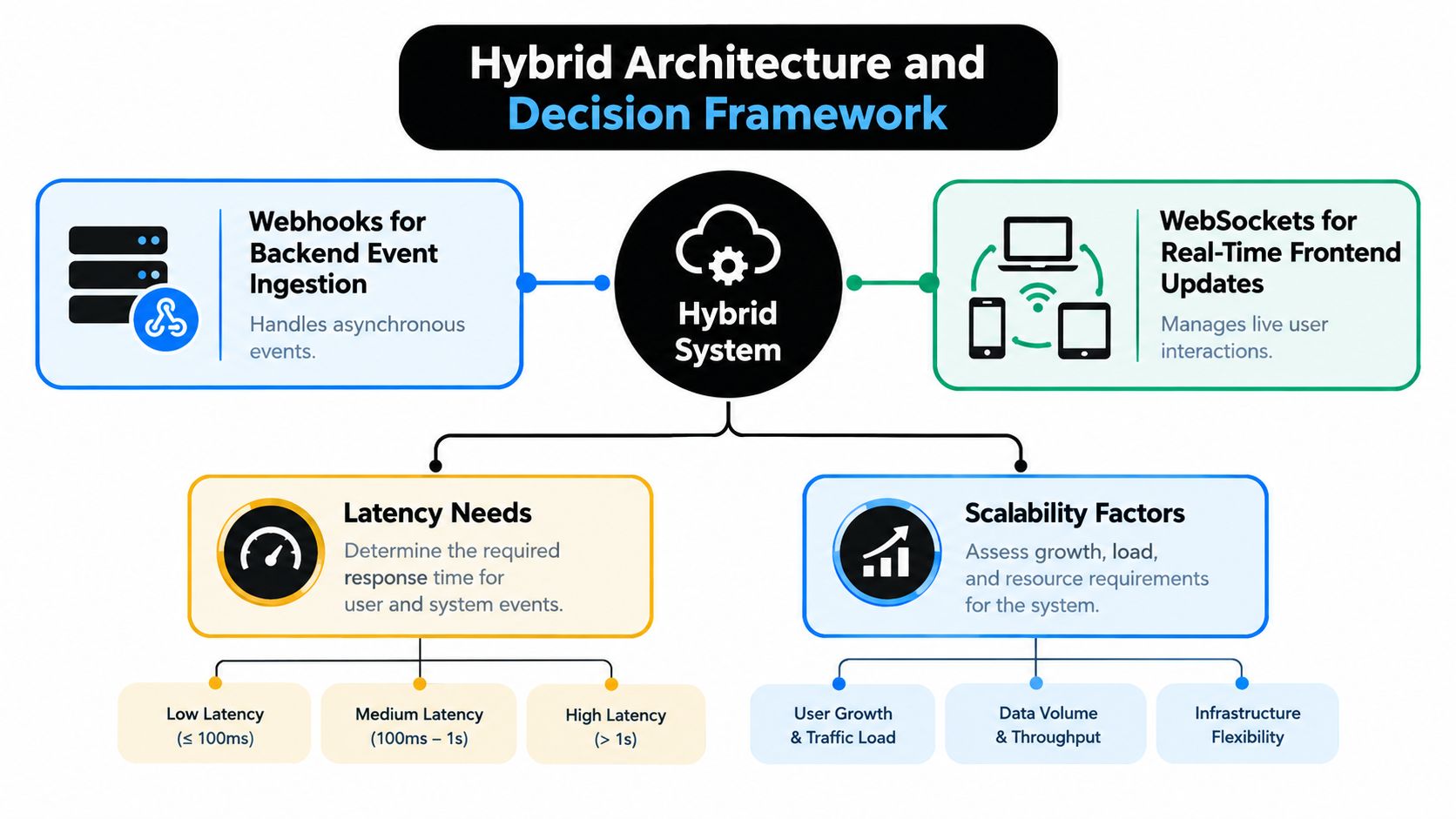
A practical hybrid architecture receives external events through webhooks, writes them to durable storage or a queue, and then publishes relevant state changes to connected users through WebSockets. The backend owns truth and recovery. The live channel owns immediacy.
That arrangement fits an AI-assisted routing system. A new inquiry arrives through a webhook, the receiver validates and stores it, a worker invokes the classification or scoring service, and the system records the result. If an operator is reviewing the queue, a WebSocket pushes the new assignment or status change to the interface. If the operator is offline, the next page load reads the stored state.
Choose by operational requirement
Use this decision framework before selecting a transport:
- Start with the business event. If losing it creates a financial, compliance, customer-service, or workflow problem, ingest it through a webhook or another durable backend mechanism.
- Define the user experience. If a connected user needs to see streaming output, live queue movement, or collaborative changes, add WebSockets where that interaction occurs.
- Specify offline behavior. Ask what the user should see after closing the browser and returning later. If the answer is “the complete current state,” the system needs persistence outside the WebSocket session.
- Limit connection scope. Don't expose a persistent channel to every service just because the frontend uses one. Keep WebSockets at the boundary where live interaction has clear value.
- Plan fan-out deliberately. One backend event may need to update several users, dashboards, or workflow steps. A message broker or application-level event layer can separate ingestion from delivery.
Teams evaluating whether to build or buy AI capabilities can use the AI tooling comparison framework to clarify where custom orchestration is necessary and where an existing service is sufficient.
Webhooks suit auditability, asynchronous processing, approvals that can wait, and integrations between systems that don't share a live session. WebSockets suit streaming interfaces, live collaboration, and operator experiences where delay disrupts the work. When both conditions apply, hybrid architecture usually avoids forcing one protocol to carry responsibilities it wasn't designed to handle.
Implementation Checklist for Internal Systems
Protocol selection becomes easier when the team writes down the failure behavior before writing the integration.
Checklist for webhook receivers
- Define the event contract: Document event names, payload versions, required fields, timestamps, and identifiers. AI workflow events should distinguish a completed result from a temporary processing update.
- Verify authenticity: Validate the provider's signature using the expected HMAC-SHA256 process, protect secrets, and reject malformed or replayed requests.
- Make processing idempotent: Store the provider event identifier and ensure a retry can't create a duplicate CRM record, payment action, or AI task.
- Acknowledge quickly: Put work into a queue or durable store before invoking an LLM, classifier, enrichment service, or downstream automation.
- Track every state: Give operators a way to find received, delayed, failed, and retried events without searching application logs.
- Test partial failure: Stop workers after persistence, interrupt downstream calls, and replay deliveries. The system should recover without manual database edits.
Checklist for WebSocket services
Start with connection ownership. Define how the server authenticates a client, how it authorizes each subscription, and how it removes stale sessions. Don't assume a connected socket represents an active user forever.
Then make reconnection explicit:
- Reconnect safely: Use bounded retry behavior and avoid creating a connection storm when an infrastructure dependency fails.
- Resynchronize state: On reconnect, let the client request current state or missed messages rather than assuming every update arrived.
- Separate transient from durable data: A typing indicator or token stream can be transient. An approved AI recommendation should be stored as a business record.
- Monitor connection health: Measure active sessions, failed handshakes, disconnect reasons, authentication failures, and delivery errors.
- Protect tenant boundaries: Filter events server-side. Never trust a browser to decide which customer or workspace messages it may receive.
Make the decision reviewable
Write a short protocol record for each workflow. State the event owner, delivery requirement, offline behavior, retry policy, security control, and user-facing latency expectation. If the team can't explain what happens during a browser close, provider retry, worker crash, or expired session, the design isn't ready for production.
Internal Systems designs and builds custom software, integrations, operational automations, and AI-powered workflows for teams that need reliable event capture alongside usable internal interfaces. If your team is deciding between webhooks, WebSockets, or a hybrid for an AI workflow, visit Internal Systems to discuss the architecture and implementation path.