Risk Assessment Automation: A Practical Playbook
Risk assessment automation playbook for founder-led growth firms. Define scope, design workflows, integrate systems, and measure ROI with practical examples.
A founder opens the risk queue on Monday and finds three new vendor requests, an overdue access review, and a customer security questionnaire waiting for an answer. The team has the information somewhere, but it's split across email, shared drives, internal tools, and conversations nobody documented. By Friday, the business has spent its operating week reconstructing context instead of making decisions.
Risk assessment automation can remove that recurring work, but it won't rescue an undefined process. The reliable approach is to standardize inputs, assign decision ownership, route exceptions deliberately, and measure whether the system improves control quality. Speed matters, but a faster wrong decision is still a risk.
Table of Contents
- When Manual Risk Review Stops Scaling
- Defining the Business Case and Scope
- Data and Integration Requirements Before You Automate
- Designing the Risk Assessment Automation Workflow
- Orchestration, Monitoring, and Human Escalation
- Choosing KPIs That Prove Decision Quality
- 90-Day Rollout Plan and Handoff Checklist
When Manual Risk Review Stops Scaling
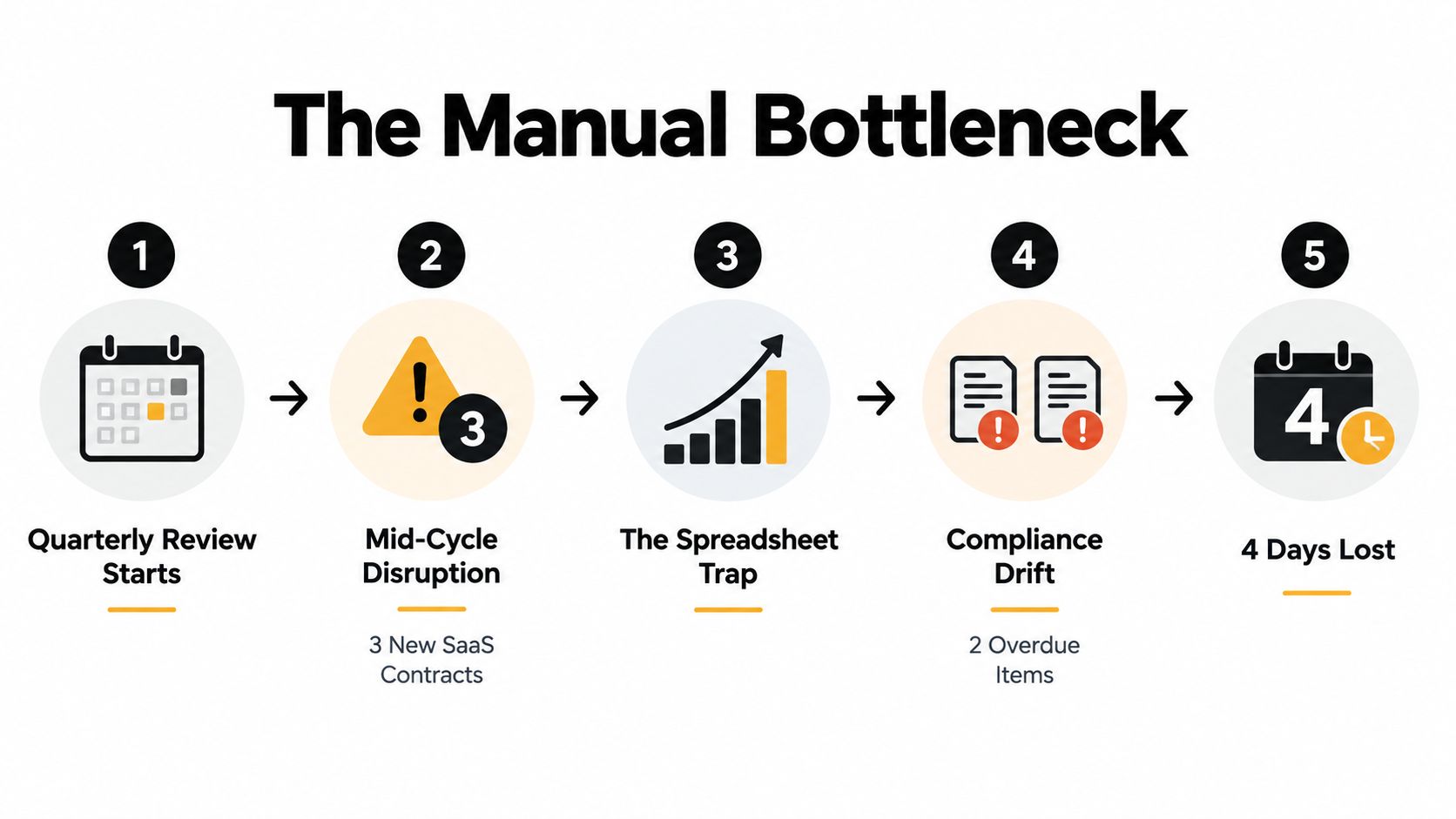
The breaking point usually arrives during an ordinary quarterly vendor review. Three new SaaS contracts landed mid-cycle, two compliance questionnaires are overdue, and the security questionnaire backlog has crept past two weeks. A founder asks why the team can't clear the queue, and the answer is not just a lack of headcount. Each review requires someone to find the right record, interpret inconsistent evidence, ask the same questions again, and decide who owns the next action.
The first structural symptom is queue latency growing faster than deal volume. Sales and procurement create requests continuously, while risk review remains a periodic, manual exercise. The second is re-derived findings. Reviewers repeatedly extract the same facts from SOC 2 reports, DPAs, access logs, and contracts because earlier conclusions aren't stored in a reusable case record.
The third symptom is ownership ambiguity. Operations believes security owns the decision, security expects finance to validate the vendor, and finance assumes the request is still with procurement. The result is a queue full of technically visible work with no accountable next step.
What automation should actually replace
Automation shouldn't replace judgment where context matters. It should replace the recurring mechanics around judgment:
- Extraction: Pull relevant fields from submitted forms, contracts, evidence files, and system events.
- Normalization: Match entities, standardize categories, and resolve duplicate records.
- Classification: Apply documented rules and model-assisted scoring to consistent inputs.
- Routing: Send each case to the right owner with a reason, deadline, and escalation path.
- Evidence capture: Write decisions, overrides, and supporting artifacts to a durable case record.
Most failed pilots automate the decision before standardizing the inputs. The model then receives incomplete records, ambiguous evidence, and inconsistent terminology. It produces a confident-looking score that reviewers can't defend, so the team returns to manual review with an expensive extra layer.
Practical rule: Automate repeated preparation and routing first. Earn the right to automate decisions by proving that the inputs and exception paths are reliable.
Defining the Business Case and Scope
Before signing a purchase order, a founder should be able to answer three questions. Which risk domains belong in version one? Which decisions can terminate with an automated action? What unit of work will the system own from intake through handoff?
Start with the domain that combines the highest review volume with the clearest bad outcome. Vendor risk may be the right choice if onboarding delays sales and weak due diligence exposes customer data. Access risk may be better if entitlement reviews repeatedly uncover stale permissions. Don't put vendor, access, transaction, and compliance workflows into one initial build unless they share the same inputs, owners, and decision rules.
A useful boundary includes intake, classification, decision, and handoff. Anything outside that boundary belongs in a later phase. The system might own a vendor onboarding packet end to end, while a legal contract exception remains a human decision with automated evidence gathering.
Consider a $5M ARR SaaS firm with 40 new vendors per quarter, a SOC 2 review in flight, and a security review SLA that customer procurement teams keep missing. Its first release could accept a vendor request, create a canonical record, collect required evidence, classify the vendor by data access and operational dependency, and route exceptions to security or finance. It shouldn't attempt to quantify every enterprise risk or replace legal review.
| Scope Decisions for v1 Risk Automation | Typical Volume | Bad Outcome If Missed | Fit for v1 |
|---|---|---|---|
| Vendor onboarding | 40 new vendors per quarter | Customer, security, or operational exposure | Strong fit if intake and evidence are repeatable |
| Access recertification | Qualitative, assess from current queue | Excessive or stale access | Strong fit when identity events are available |
| Transaction review | Qualitative, depends on transaction flow | Fraud, payment, or compliance exception | Fit when signals and escalation owners are defined |
| Broad compliance program | Qualitative, spans multiple teams | Missing evidence and unclear accountability | Usually too broad for the first release |
The business case should connect the workflow to a measurable operating outcome, such as review latency, owner coverage, or exception closure. A custom build versus buying a tool also depends on integration depth, decision complexity, and who must own the workflow after launch. Use this build-versus-buy comparison for AI tooling to frame that decision, then scope tightly enough that payback can be assessed in one quarter.
Data and Integration Requirements Before You Automate
No model output is defensible until its inputs are standardized. A risk model can rank cases, summarize evidence, and identify patterns, but it can't correct a vendor record that refers to the same company under three names or infer a missing policy decision without creating an unsupported assumption.
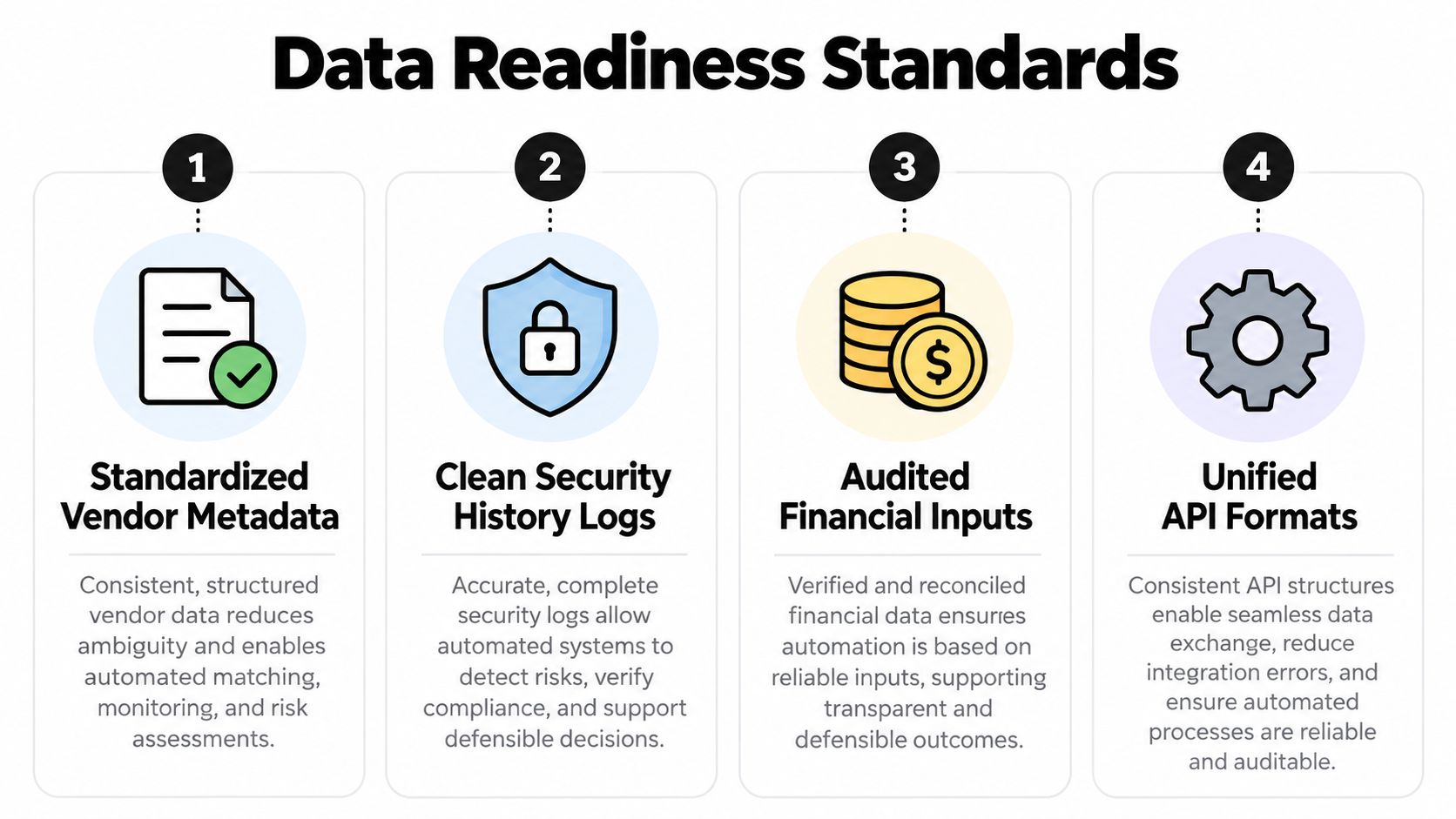
Four input classes usually determine whether an automation program earns trust.
The four classes of usable input
Entity records describe vendors, employees, systems, accounts, and business units. Each entity needs a stable identifier, an owner, and enough metadata to distinguish related legal entities or duplicate records.
Evidence artifacts include SOC 2 reports, DPAs, penetration-test summaries, insurance certificates, and approval documents. Store them with source, effective date, scope, and evidence type, rather than treating a shared-drive filename as structured data.
Event signals show what changed. Ticket creation, contract execution, access changes, anomaly alerts, and failed control checks should use a tagged taxonomy so the workflow can distinguish a new request from a recurring exception.
Policy rules define approved risk tiers, escalation matrices, review deadlines, and prohibited actions. A policy hidden in a Notion page is difficult to execute consistently. A versioned policy store gives the scoring service a traceable rule set.
Founder-led firms often have vendor records in spreadsheets, evidence in shared drives, events scattered through Slack and email, and policy decisions embedded in personal knowledge. Connecting those systems without normalization creates a pipeline that moves inconsistency faster.
A readiness checklist
| Input class | Source system | Accountable owner | Normalization step |
|---|---|---|---|
| Entity records | Vendor, identity, and asset systems | Operations or IT | Create canonical vendor and system IDs |
| Evidence artifacts | Document storage and intake forms | Security or compliance | Apply a tiered evidence schema |
| Event signals | Tickets, webhooks, and monitoring tools | Engineering or operations | Use a tagged event taxonomy |
| Policy rules | Governance repository | Risk owner | Store versioned, executable policies |
The integration sequence is simple: standardize first, connect second, automate third. A custom AI workflow should read from stable contracts and write to a case record, not depend on ad hoc parsing from whichever tool happens to contain the latest note. An example of a risk prediction system illustrates the broader engineering principle: useful predictions depend on a defined input model, reliable signals, and an operational destination for the result.
Designing the Risk Assessment Automation Workflow
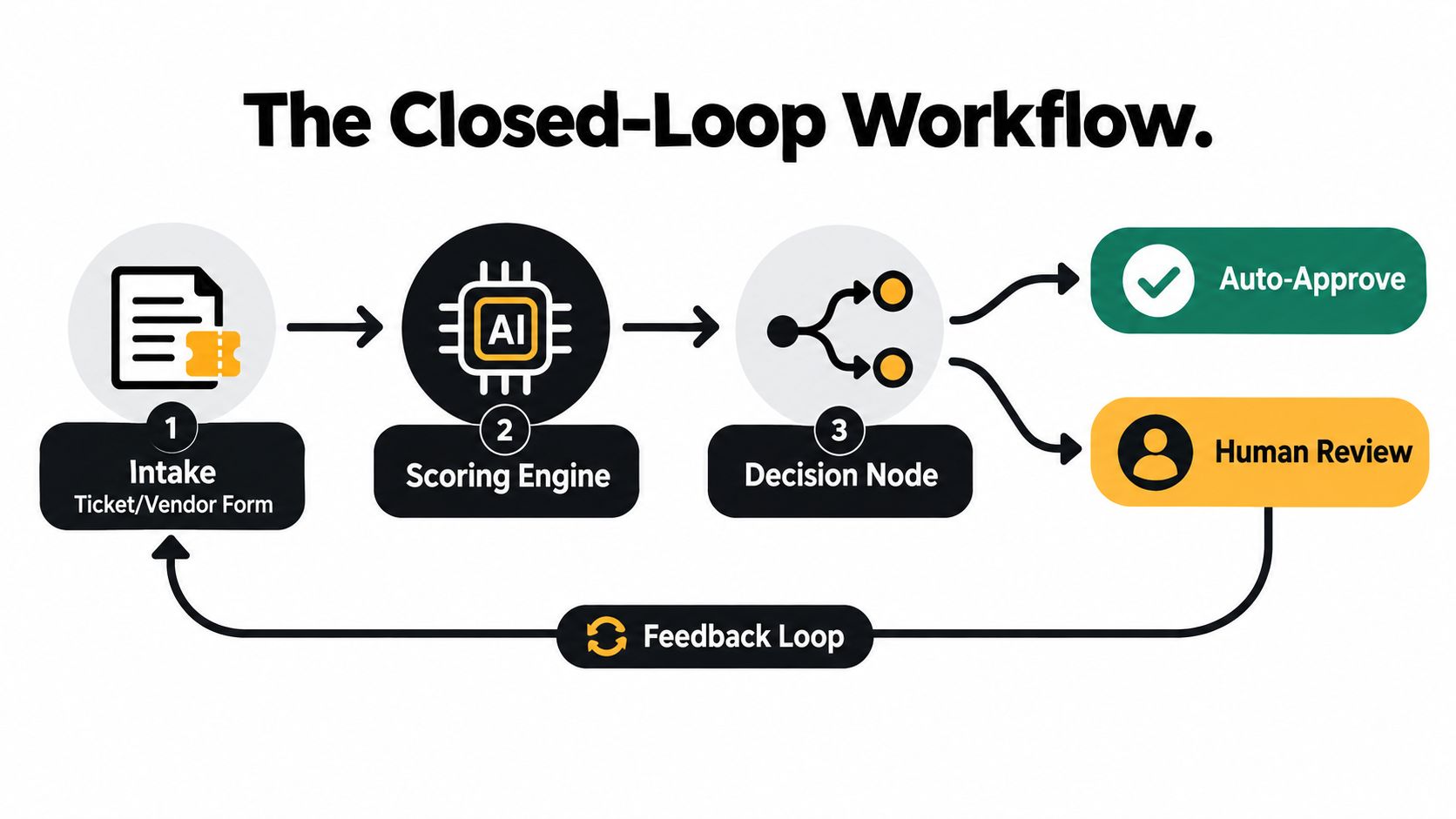
Treat the automation as a closed-loop pipeline, not a model dropped into a reporting screen. Every case needs a named intake, a scoring service, a decision node, an accountable owner, and a record of what happened afterward.
The intake might be a vendor onboarding form, an access request, or a ticket created by a monitoring service. The scoring service should return a tier such as low, medium, high, or critical, alongside explicit reason codes. “High risk” isn't actionable unless the reviewer can see which data access, control failure, exposure, or event caused the classification.
Separate detection from judgment
A practical design uses three layers:
- Detection applies deterministic checks for known patterns, such as missing evidence, expired documents, prohibited countries, or unusual access changes.
- Enrichment adds context from sanctions data, adverse-media services, internal watchlists, contracts, asset inventories, and prior case history.
- Judgment uses a lightweight model to weigh severity, velocity, and exposure, while preserving the signals that influenced the result.
Low and medium cases may auto-resolve when required evidence is present and no exception rule fires. High cases should route to a domain reviewer. Critical cases should notify an accountable executive or on-call owner. Those actions need explicit policy definitions, not assumptions buried inside application code.
Every node should write to the same case record. That record should include the original input, normalized entities, evidence references, score, reason codes, decision, owner, deadlines, human overrides, and final outcome. Human overrides are not noise. They provide the feedback needed to tune rules and scoring weights, while exposing recurring ambiguity in the process.
The failure paths must be visible:
- Missing data: pause the case and request a named artifact.
- Ambiguous signal: lower confidence and route to review.
- Conflicting sources: preserve both values and escalate rather than selecting one.
- Service failure: retry safely, record the failure, and notify the workflow owner.
The automation should also monitor its own control behavior. Guidance on risk management automation emphasizes repeated review of detection and response times, control pass rates, owner coverage, and evidence freshness. A workflow that generates decisions but doesn't track these outcomes is only automating activity.
Orchestration, Monitoring, and Human Escalation
For a firm between $1M and $20M, orchestration should match the operating shape of the workflow rather than the novelty of the technology. A synchronous API call works when a person can't proceed until the system returns a decision. Event-driven processing works when the business needs repeated monitoring without blocking the initiating action.
| Dimension | Synchronous (API) | Event-Driven (Queue/Schedule) |
|---|---|---|
| Best fit | Vendor onboarding and access requests | Transaction screening, vendor refresh, and posture drift |
| Latency expectation | Immediate decision within the intake flow | Minutes to hours, depending on event urgency |
| Failure handling | Return a clear pending or review state | Retry, dead-letter, and notify an owner |
| Operating risk | Intake can block if dependencies fail | Events can accumulate without queue monitoring |
| Example | Approve or route an access request | Recheck vendor evidence when a signal changes |
Synchronous orchestration suits a new vendor request where procurement needs a decision before moving forward. The API can validate required fields, call enrichment services, score the case, and return either an approved state or a named review queue. It must also support a pending state, because pretending that a failed enrichment call is a low-risk result creates silent exposure.
Event-driven orchestration fits continuous monitoring. A webhook can create a case when a vendor's posture changes, while a scheduled job can refresh evidence or re-evaluate entities against updated policy rules. Queues isolate slow external services from the user-facing workflow, but they introduce operational responsibilities around retries, duplicate events, ordering, and backlog visibility.
Alerting should follow blast radius
Informational signals belong in logs. Low-risk changes can notify the case owner. Medium-risk findings should create an operations ticket. High-risk findings should reach the security or compliance committee, with a documented response SLA and escalation if nobody acknowledges the case.
Set human review thresholds before production. Examples include confidence below 0.7, conflicting sources, or repeat findings on the same entity. The threshold isn't a universal truth. It's a policy choice that should be tested against actual overrides and failure costs.
Monitor pipeline health separately from risk output. Queue depth, enrichment success rate, override frequency, and time-to-decision reveal whether the system is functioning, while the score itself only describes the case. An insurance operations dashboard example shows why operational visibility needs its own surface rather than being buried inside a model report.
Choosing KPIs That Prove Decision Quality
Speed metrics alone reward lazy automation. A system can reduce review time by auto-approving anything it can't classify, which makes the dashboard look healthy while weakening control quality.
Start with override precision. Of the cases the model auto-resolved, what fraction did a human reverse within 30 days? Pair that with override recall. Of the cases a human ultimately escalated, how many did the model flag at all? These measures expose both overconfidence and missed risk.
Cycle time belongs in the KPI tree, but it should remain secondary. The primary question is whether the system makes a defensible decision with the right owner and evidence.
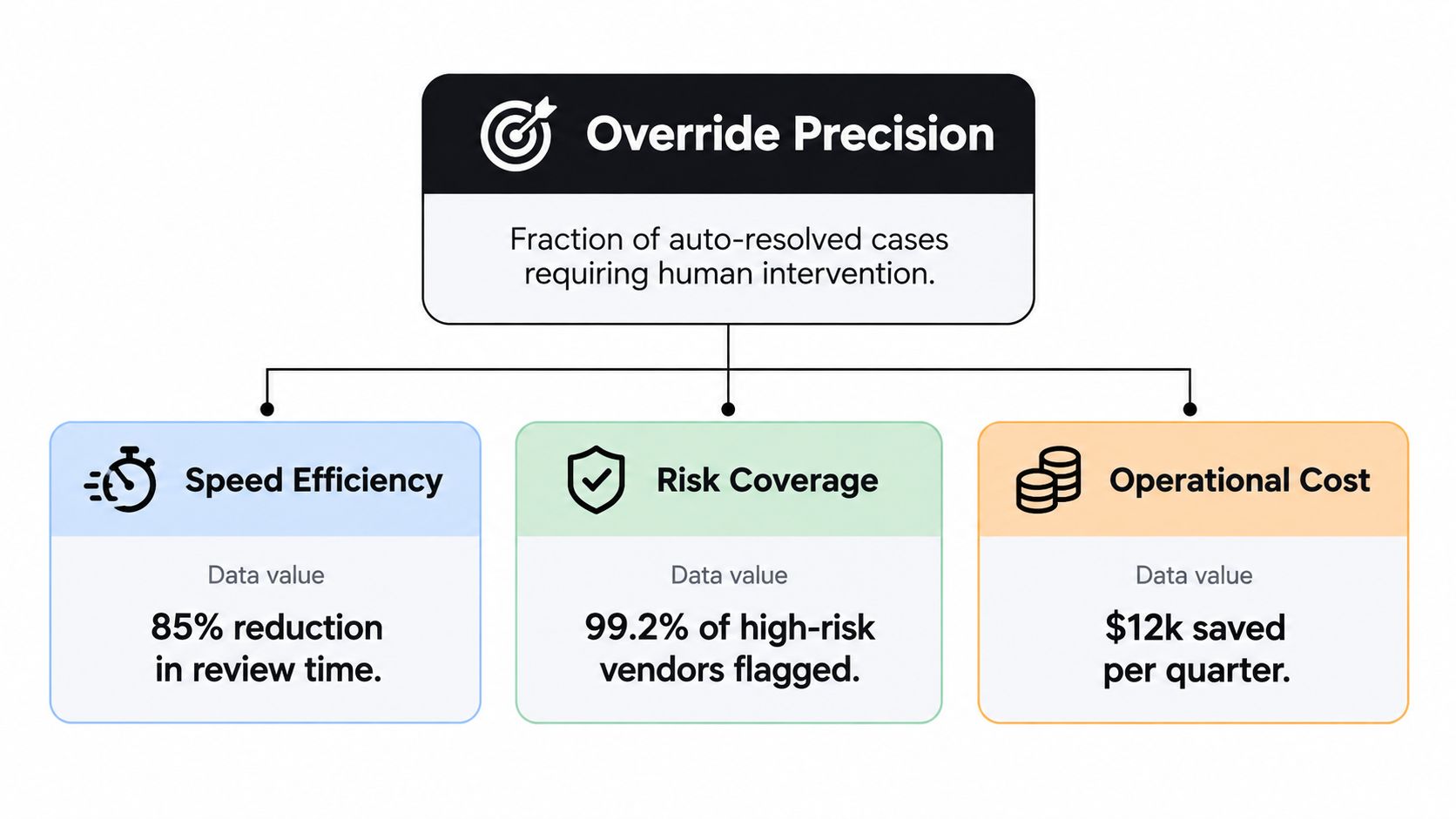
KPI trees by risk domain
Vendor risk should connect onboarding performance to downstream exposure:
- Onboarding time: How long a complete request takes to reach a decision.
- Concentration index: How much operational dependency sits with a small group of vendors.
- Post-onboarding incident rate: Whether approved vendors later generate material exceptions.
Access risk needs entitlement quality, not just review completion:
- Standing-access count: Persistent privileges that don't require a current business action.
- Entitlement creep: Privilege accumulation across role or team changes.
- Review completion rate: Whether owners complete access decisions within the required cycle.
Financial risk should distinguish useful alerts from expensive noise:
- Exception rate: The share of transactions requiring intervention.
- False-positive dollar volume: The value associated with alerts that reviewers dismiss.
- Recovery time: How long it takes to resolve a confirmed financial exception.
Every metric needs a named owner and a monthly review cadence. If nobody owns the number or discusses it in a recurring meeting, it isn't an operating KPI. It becomes a vanity figure that survives because the dashboard has space for it.
A risk score is an input to a decision. The decision quality measure is what happens after the score, including reversals, missed escalations, and unresolved ownership.
The governance context is becoming more formal. The EU AI Act entered into force in 2024 and established risk tiers for AI systems, while financial uses such as creditworthiness evaluation, credit risk classification, and fraud detection are treated as high-risk applications with stronger expectations for transparency, resilience, and human oversight. The analysis of the EU AI Act and financial risk assessment also describes how the UK's PRA SS1/23 places in-scope AI systems within model risk management, including development, validation, governance, and ongoing monitoring.
90-Day Rollout Plan and Handoff Checklist
A rollout should be gated by ownership and evidence, not by whether a vendor demo looked convincing. The sequence below keeps the first release narrow and forces the team to prove that the workflow works before adding more models or risk domains.
Days 1 through 30
Lock the domain, unit of work, decision boundary, and exception policy. Name one accountable owner, baseline the current review cycle, and finalize the integration list. Founder-led firms often stall here because they buy a platform before deciding which workflow it will own.
The owner should also define the source of truth for entities, evidence, events, and policies. If the team can't agree on those records, implementation should pause rather than hide the disagreement inside an AI layer.
Days 31 through 60
Ship the closed-loop workflow in shadow mode. The automation produces classifications and routes without controlling the live decision, allowing reviewers to compare outputs against manual decisions for at least 200 cases. Review disagreement patterns before tuning thresholds. A single aggregate accuracy figure won't explain whether the system fails on missing evidence, unusual entities, or conflicting sources.
Days 61 through 90
Promote the workflow to live operation with named escalation owners for every risk tier. Publish the runbook and run two tabletop exercises covering a missing dependency, an incorrect classification, an unavailable reviewer, and a conflicting evidence source. The exercises should test handoff readiness, not just whether the application returns a score.
| 90-Day Risk Assessment Automation Rollout Phases | Days | Key Activities | Owner | Exit Criteria |
|---|---|---|---|---|
| Foundation | 1 to 30 | Lock scope, name owner, baseline cycle time, confirm integrations | Operations lead | Scope, data contracts, and escalation rules approved |
| Shadow mode | 31 to 60 | Run workflow beside manual review, compare at least 200 cases, inspect disagreements | Risk workflow owner | Thresholds supported by reviewed disagreement patterns |
| Live handoff | 61 to 90 | Activate routing, publish runbook, conduct two tabletop exercises | Operations and domain owners | On-call coverage, escalation paths, and evidence records tested |
Handoff checklist
- Documentation: Record workflow purpose, inputs, policies, model behavior, reason codes, and known limitations.
- On-call coverage: Assign a person for pipeline failures and a person for each risk-tier escalation.
- Retraining cadence: Define when human overrides and new outcomes are reviewed for scoring updates.
- Audit trail: Preserve source evidence, decisions, overrides, timestamps, and policy versions.
- Quarterly review: Re-validate the original ROI assumptions, control quality, ownership coverage, and response performance.
Regulatory and governance guidance increasingly treats AI as a controlled operating environment rather than an experimental add-on. Microsoft's recommended sequence is to assess organizational risks, document governance policies, enforce those policies, and monitor risks over time, beginning with the workload's purpose, scope, data sources, and intended outcomes. The AI risk management guidance provides a useful reference for structuring that sequence.
Internal accountability matters just as much as model behavior. Every automated process needs a named owner and a regular review cycle so documentation, assessments, and control descriptions stay aligned with the system in production. The risk-governance discussion of automation ownership reinforces that a generic operations queue isn't a substitute for explicit responsibility.
Internal Systems designs and builds custom software, integrations, and AI-enabled workflows for operational teams that need risk assessment automation grounded in their actual processes. If your vendor, access, or client-risk workflow is fragmented across tools, visit Internal Systems to discuss an Operations Audit or a focused custom build with clear ownership and handoff.