Open Source LLMs for Operations: A Practical Leader's Guide
A practical guide to open source LLMs for operations leaders, covering benefits, licensing, deployment, evaluation, and real adoption tradeoffs.
The popular advice is to find the highest-ranked open source LLM, download it, and build around it. That advice is backwards. Model selection is a deployment decision, and the model comes second.
An operations team needs to decide where inference will run, which data can cross a trust boundary, who owns uptime, how the model connects to internal workflows, and whether the team can maintain the surrounding MLOps stack. A benchmark winner can still lose inside a claims workflow because its license complicates procurement, its latency disrupts queue processing, or its runtime requires more infrastructure than the business can support.
Open source LLMs now matter at infrastructure scale. A 2026 measurement report counted about 1.5K mainline open models, with tracked downloads reaching 2.04 billion by March 2026, compared with 339 million in March 2025, a sixfold year-over-year increase. The ecosystem is no longer a developer curiosity. It's a serious deployment option, but only when leaders judge it by total process cost and operational ownership.
Table of Contents
- Reframing the Open Source LLM Decision
- What Open Source LLMs Actually Are
- Benefits and Risks for Internal Systems
- Licensing and the Open-Weight Distinction
- Deployment Modes and Cost Tradeoffs
- MLOps and Integration Patterns for Operations
- Evaluation Checklist Before You Build
- A 90-Day Adoption Roadmap and FAQ
Reframing the Open Source LLM Decision
The wrong question is, “Which open source LLM is best?” Ask instead, “Which deployment mode gives this internal workflow the lowest total cost and acceptable risk?”
That choice changes the selection process. A hosted API, a self-hosted model, and an on-device model may use similar weights while creating different responsibilities for security, finance, engineering, and operations. The model is one component. The operating model determines how much control you gain and how much work your team inherits.
Start with the operating model
Hosted inference provides a managed endpoint. Your team still owns prompts, retrieval, access control, evaluations, and business rules, while another party operates much of the serving layer. Self-hosting gives you more control over data residency, runtime configuration, and upgrades. It also makes your team responsible for capacity, patching, observability, and failure recovery. On-device inference creates the strongest local boundary, but hardware limits can restrict model size, throughput, and context handling.
A procurement workflow makes the tradeoff clear. A public leaderboard may favor a model with strong reasoning, while the workflow requires predictable response times, strict document residency, structured JSON, and an audit trail for every recommendation. A smaller model with a permissive license and stable serving stack can be the better production choice.
The right model is the one your team can operate reliably inside the workflow.
Practical rule: Choose the deployment mode first. Select the model that fits that mode and the workflow's failure tolerance.
Enterprise adoption supports this shift from experimentation to operational use. A Databricks industry report says 76% of organizations using LLMs choose open source models, often alongside proprietary alternatives, while 11 times more AI models entered production year over year during the reported period. Another survey cited in the same report found more than half of respondents using open source across data, model, and tools layers, and 73% expected to increase open source GenAI use over the next two years.
These figures indicate broader standardization, not a universal case for self-hosting. Open source wins when control, integration, and security justify operational ownership. Closed models win when managed reliability and rapid deployment matter more. Treat model selection as the consequence of that deployment decision, not as a benchmark contest.
What Open Source LLMs Actually Are
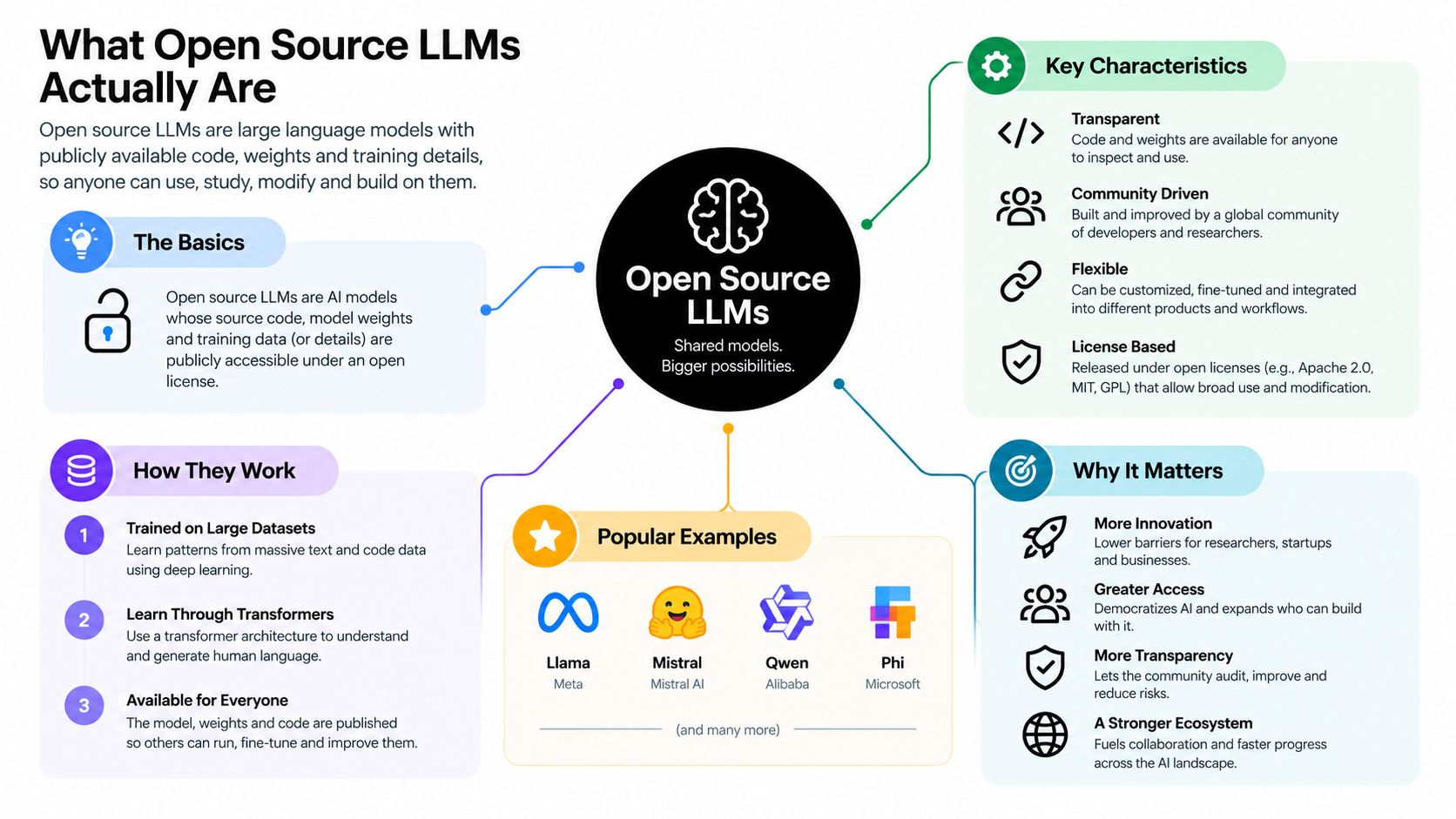
“Open source LLM” describes several different release practices. Operations leaders need to separate fully open source models, open-weight models, and proprietary APIs before approving a pilot.
A fully open model makes substantially more of the development process available, potentially including weights, code, training data, checkpoints, and documentation. The Allen Institute's Olmo 3 release is a useful example of the fully open approach because it describes a model flow with publicly available data, code, weights, and checkpoints.
An open-weight model publishes trained parameters, often allowing downloading, fine-tuning, and local deployment, but it may not publish the full training data or training process. Qwen, Llama, and Mistral releases can sit at different points on this spectrum, so the family name alone doesn't answer the legal or operational question.
A proprietary API is the most managed option. You send requests to a vendor, receive outputs, and operate within that vendor's terms, limits, retention settings, and availability model.
Use a simple kitchen analogy
Fully open source is the recipe, ingredients, and cooking instructions. You can inspect how the dish was made, alter the recipe, and reproduce the process if you have the required kitchen.
Open weight is the finished dish you can reheat and modify. You have the central artifact, but not necessarily the complete ingredient list or cooking history.
A proprietary API is a meal you can only order. You can specify what you want and evaluate the result, but you can't inspect or operate the kitchen.
This isn't a binary category. It's a licensing and transparency gradient. Before procurement, ask for the model card, license text, acceptable-use policy, training-data disclosure, redistribution terms, and rules for fine-tuned or derived weights. Also ask whether the provider offers indemnity, support, security documentation, and a clear process for license changes.
The Vellum open LLM leaderboard reinforces why model cards and current evaluations matter. It excludes outdated benchmarks and highlights tasks such as Terminal-Bench 2.1, which test tool use and agentic behavior more directly than saturated legacy tests. A model's label tells you less than its artifacts and deployment terms.
Benefits and Risks for Internal Systems
Open source LLMs offer control, but control is not free. The operational comparison should cover data residency, cost predictability, customization, vendor lock-in, latency, uptime, and security review effort, not just model quality.
An insurance operations team might run a local model over sensitive policy documents, use proprietary ticket data for targeted adaptation, and keep inference inside a controlled environment. A team with high, stable usage might also prefer infrastructure costs it can forecast rather than exposure to changing per-token pricing.
The tradeoff appears in the table below.
Open Source LLMs vs. Closed APIs: Operational Tradeoffs
| Dimension | Open Source LLMs | Closed APIs |
|---|---|---|
| Data residency | Can keep prompts and documents within owned or approved infrastructure | Depends on vendor region, retention, and contractual controls |
| Cost predictability | More fixed infrastructure and staffing cost, less dependence on token pricing | Lower initial setup, variable usage cost |
| Customization | Supports local prompting, fine-tuning, quantization, and model routing | Customization is limited to vendor features and supported tuning |
| Vendor lock-in | Greater portability when weights and serving code are usable | API contracts, model behavior, and vendor changes create dependency |
| Latency | Can be optimized for a known workload and hardware profile | Benefits from managed scale, but network and provider load affect response time |
| Uptime | Your team owns redundancy and recovery | Provider operates availability, subject to contract and service limits |
| Security review | Requires review of artifacts, runtime, infrastructure, and access controls | Requires review of data handling, subprocessors, retention, and vendor controls |
The enterprise evidence is mixed, which is precisely why blanket advice fails. Menlo Ventures found open-source usage in enterprises fell from 19% to 13% over six months, while closed-source models powered 87% of enterprise workloads, according to the McKinsey discussion of open source AI. The same source describes open source as common where it fits existing systems and security protocols.
Count the costs you inherit
Self-hosting moves spending from variable opex toward fixed infrastructure cost and specialist talent. The bill includes GPU capacity planning, model upgrades, patching, observability, security hardening, incident response, and performance tuning. It also includes idle capacity when internal demand is uneven.
A closed API can therefore be the more responsible choice for an early document-classification workflow, especially if the team lacks an owner for inference operations. Open source becomes compelling when sensitive data, customization, predictable control, or integration requirements make vendor dependence more expensive than operating the stack.
For a custom workflow such as an insurance operations dashboard, evaluate the entire process. The right question isn't whether the model is open. It's whether the deployment reduces manual handling without creating a new platform that nobody owns.
Licensing and the Open-Weight Distinction
Public weights don't automatically mean unrestricted commercial use. Treat model licensing the way you'd treat software licensing, with one important warning: AI licenses often combine familiar permissions with model-specific conditions.
Apache 2.0, MIT, and BSD licenses are generally permissive software licenses. A custom community license, research license, or source-available agreement may grant useful rights while restricting redistribution, scale, acceptable uses, or model training. The Hugging Face overview of local LLMs identifies Qwen3, Mistral Small 3.1, Devstral, Phi-4-mini, and gpt-oss as commercially friendly models, while classifying Llama 4 and Gemma 3 as open-weight rather than fully open source.
Think of the difference as open-source software versus freeware with conditions. Both may be downloadable, but only one may provide a straightforward path to modification and redistribution.
Put candidates into three buckets
| Model Family | License | Commercial Use | Derived Weights | Internal Use Fit |
|---|---|---|---|---|
| Qwen3 | Apache 2.0, as described in the cited overview | Generally permissive | Check notice and license obligations | Strong candidate, subject to standard review |
| Mistral Small 3.1 | Apache 2.0, as described in the cited overview | Generally permissive | Check downstream terms | Strong candidate, subject to standard review |
| Devstral | Commercially friendly license, as described in the cited overview | Generally suitable, verify current terms | Review adaptation and redistribution terms | Suitable with light review |
| Phi-4-mini | Commercially friendly license, as described in the cited overview | Generally suitable, verify current terms | Review derivative restrictions | Suitable with light review |
| gpt-oss | Commercially friendly license, as described in the cited overview | Generally suitable, verify current terms | Review model-specific obligations | Suitable with light review |
| Llama 4 | Open-weight custom license | Conditional | Review derived-model and use restrictions | Legal review before adoption |
| Gemma 3 | Open-weight terms | Conditional | Review model-specific obligations | Legal review before adoption |
For an internal-only deployment, a standard operations team can usually begin with a permissive license after confirming the current text, notices, and acceptable-use terms. A custom or conditional license deserves light legal review before fine-tuning or embedding the model in a product. Research-only terms should be avoided for business workflows.
Review four issues before a model enters production:
- Derived weights: Confirm whether fine-tuned, distilled, merged, or quantized versions inherit obligations.
- Acceptable use: Check whether the intended classification, decision support, or agent workflow is restricted.
- Indemnity: Don't assume the model provider covers intellectual-property or output risk.
- Redistribution: Determine what happens when prompts, logs, adapters, or outputs leave the internal boundary.
Internal use isn't always isolated use. A customer-facing assistant, an outsourced operations team, or a partner integration can turn an internal prototype into redistribution. Store the exact license version, model checksum, notices, and approval decision with the deployment record.
Deployment Modes and Cost Tradeoffs
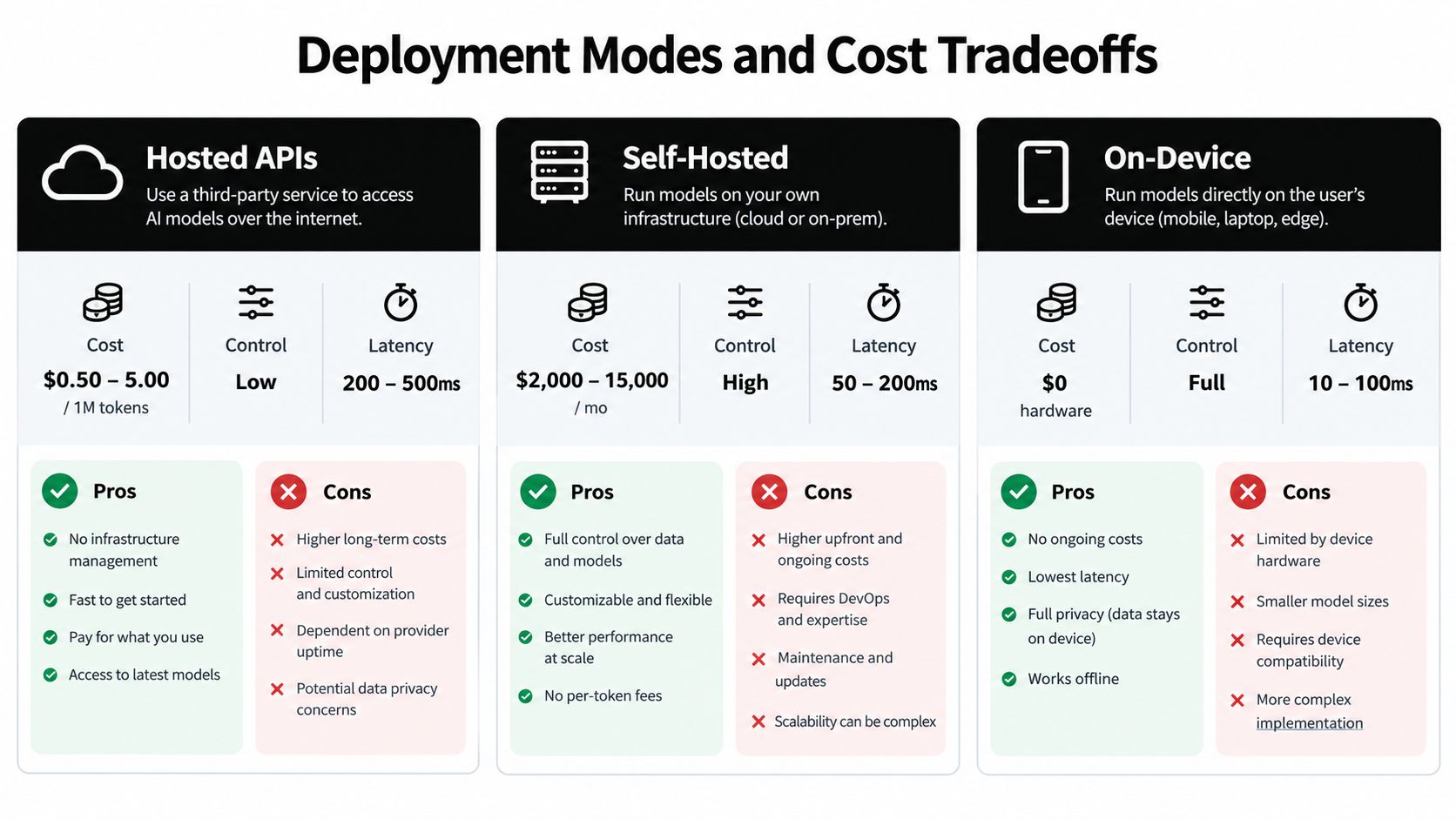
There are three practical deployment modes: hosted APIs, self-hosted inference, and on-device or edge inference. Each optimizes a different constraint.
Hosted APIs minimize platform ownership. Self-hosting maximizes control. On-device deployment minimizes data movement and network dependence. None is automatically cheaper, faster, or safer across every internal workflow.
Match the mode to the workload
Hosted APIs charge primarily through usage. They suit irregular demand, fast pilots, and teams that need managed reliability. They also create an external data boundary and leave you exposed to vendor pricing, model retirement, rate limits, and behavior changes.
Self-hosted inference concentrates cost in GPU capacity, serving software, storage, networking, monitoring, and people. It fits high-volume classification, controlled document processing, and workflows where residency or customization matters. The team must own capacity planning and recovery, including periods when the GPUs sit idle.
On-device inference uses local hardware. It suits field operations, offline processing, private workstation workflows, and small models that can meet the quality bar without a network call. It struggles when the task requires large context, high concurrency, or frontier-level reasoning.
The correct break-even point depends on model size, quantization, utilization, output length, hardware pricing, redundancy, and staffing. Don't accept a generic claim that self-hosting becomes cheaper at a particular token volume. Build a workload-specific model using your actual request distribution.
A useful comparison includes:
- Usage: Estimate monthly input and output tokens for document summarization, ticket triage, and classification.
- Capacity: Measure tokens per second, concurrency, and memory headroom on the target hardware.
- Ownership: Include observability, retraining, security reviews, idle capacity, and on-call coverage.
- Fallback: Price the closed API or alternate model required during incidents and upgrades.
The open LLM statistics leaderboard reports throughput and time-to-first-token, metrics that matter directly to interactive automation and agentic workflows. Use those operational measures alongside quality results.
A hybrid design often gives the best balance. Route routine classification to a small local model, send ambiguous cases to a hosted model, and retain a human approval step for high-impact decisions. For teams comparing a custom system with packaged tooling, build-versus-buy AI tooling should be evaluated against the same workload, ownership, and exit criteria.
Self-host when residency and steady demand justify platform ownership. Use hosted APIs when speed and managed reliability dominate. Use on-device inference when the workflow must remain local and the model can meet the task threshold.
MLOps and Integration Patterns for Operations
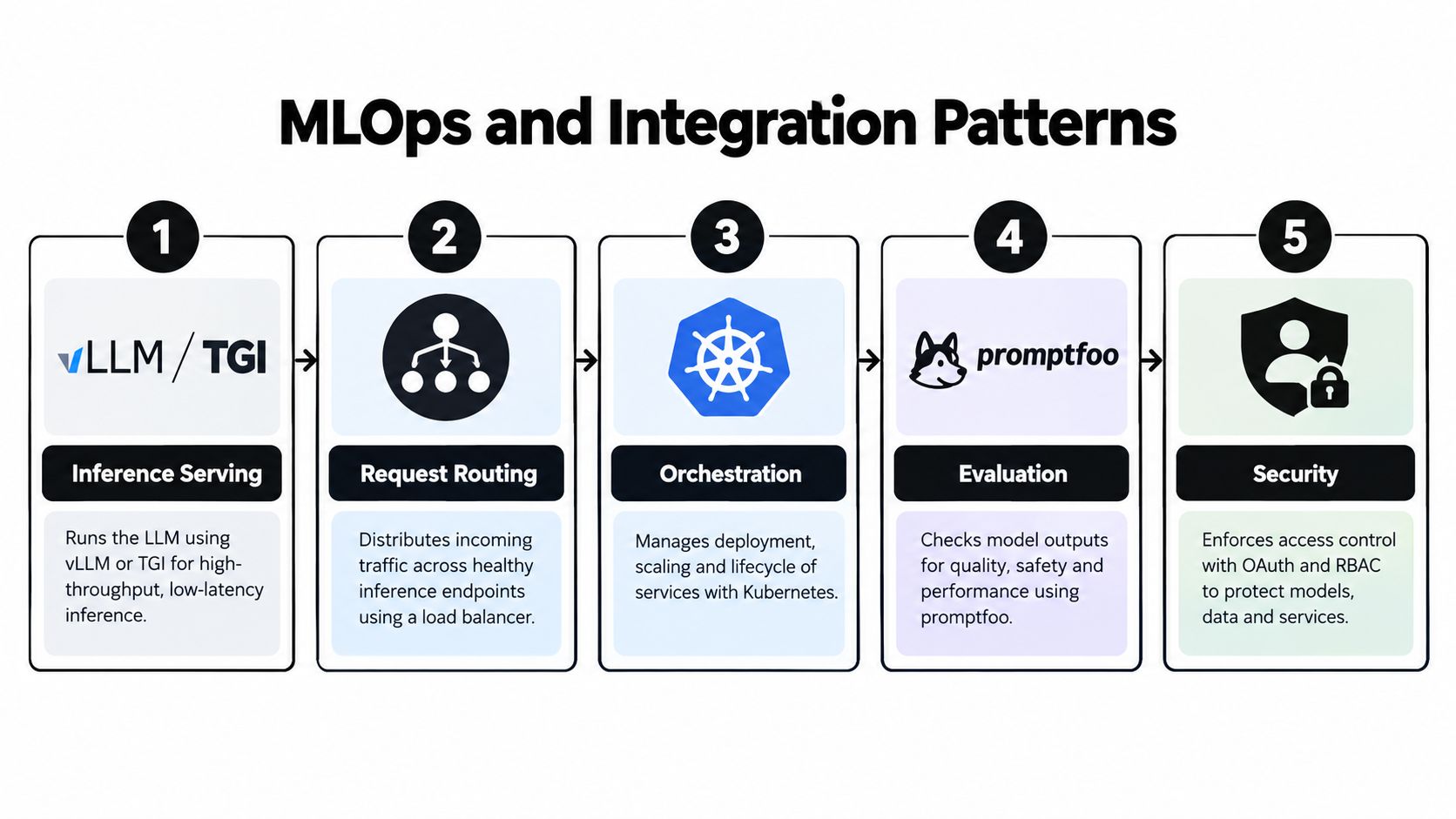
An open model becomes an internal product only after you wrap it in controls. The minimum stack needs inference serving, request routing, orchestration, evaluation, observability, and security.
A practical architecture places an API gateway in front of one or more model servers such as vLLM, TGI, or llama.cpp. The gateway handles authentication, redaction, rate limits, and routing. A retrieval and tool-calling layer supplies approved context, while a workflow engine or agent framework coordinates tasks. An evaluation and observability plane records prompts, outputs, latency, cost, tool calls, and failures.
Three patterns that survive production
1. Confidence-based routing. A small local model handles ticket labels, intent classification, and straightforward extraction. The routing layer escalates low-confidence or policy-sensitive cases to a larger hosted model or a human queue. This keeps routine traffic inexpensive without forcing one model to handle every edge case.
2. Redacted retrieval-augmented summarization. The gateway removes or masks sensitive fields before the request reaches the model. A retrieval layer fetches approved internal documents, adds citations or document identifiers, and asks the model to produce a structured summary. The workflow stores the source set and output together so an operator can verify the result.
3. Rule-constrained decision support. A copilot calls approved tools, validates returned values against deterministic rules, and surfaces its reasoning inputs and confidence to the operator. It can recommend an escalation, but a policy engine should decide whether the action is permitted.
For a portfolio or client workflow, a client portfolio agent can follow this pattern by combining retrieval, structured outputs, tool calls, and human approval rather than allowing unrestricted autonomous actions.
Security controls belong in the architecture
- PII handling: Define what gets redacted, retained, encrypted, or deleted.
- Secrets management: Keep credentials outside prompts, logs, model context, and tool arguments.
- Artifact provenance: Record the model source, version, license, checksum, adapters, and quantization method.
- Access control: Apply service identities, role-based permissions, and least-privilege tool access.
- Audit logging: Capture the request, retrieved context identifiers, model version, tool calls, output, reviewer action, and final decision.
- Failure handling: Set timeouts, retries, circuit breakers, fallback models, and human escalation paths.
The model server is only one dependency. Production reliability comes from controlling every boundary around it.
Evaluation Checklist Before You Build
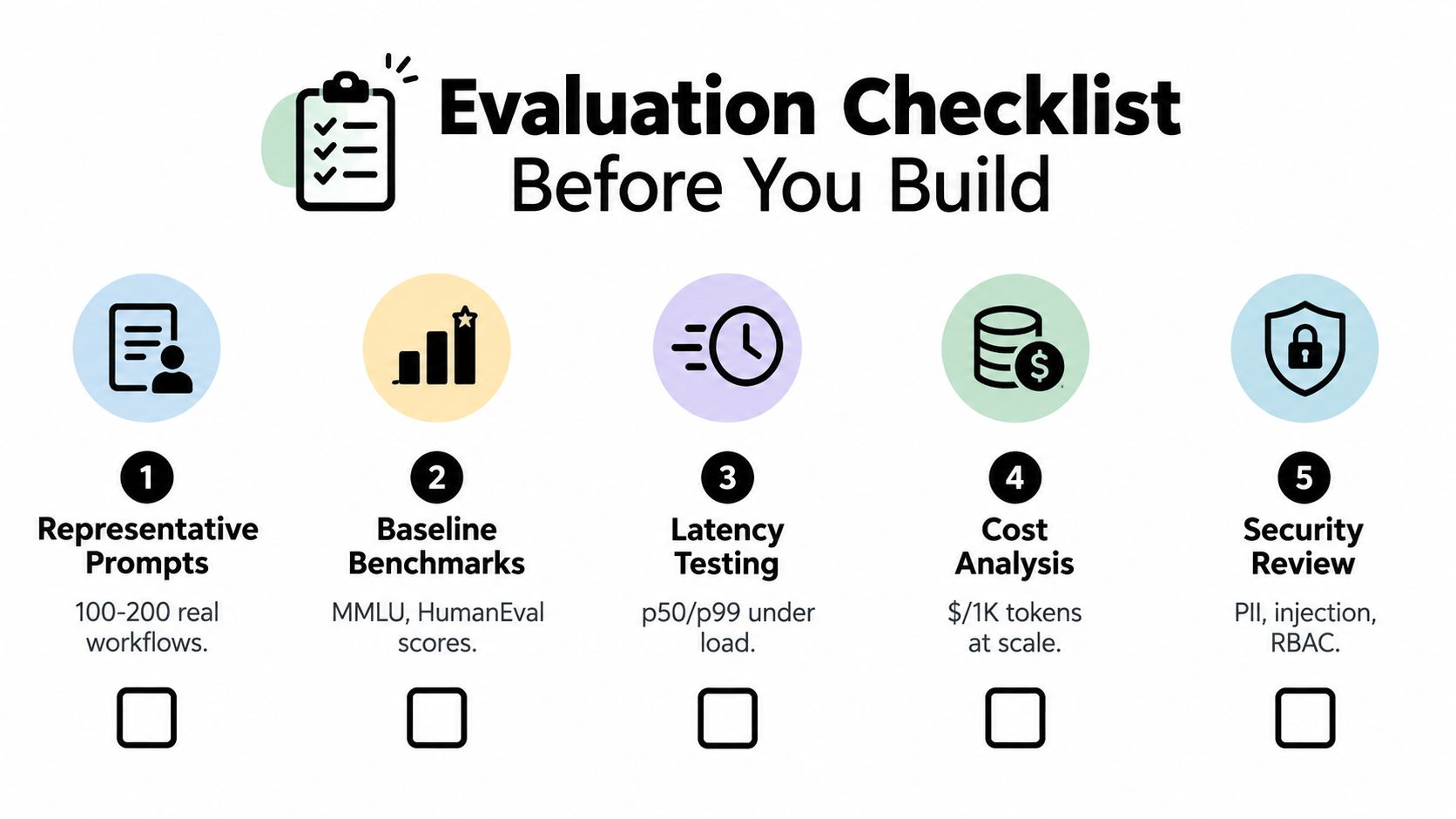
A leaderboard can narrow the field, but it cannot choose your deployment mode. Test each candidate against the work, data, controls, and operating capacity your internal system requires. Use a local harness and compare results with the current API or model.
Build the test set from 100 to 200 representative prompts covering support routing, contract summarization, exception triage, or the workflow under consideration. Include routine and ambiguous cases, long documents, malformed inputs, and requests that should be refused. A polished demo is not evidence of production fit.
Score the workflow, not the demo
Have domain reviewers assess accuracy, hallucination, format adherence, latency, and refusal behavior. Validate extraction fields against a gold output. For summaries, check required facts and prohibited details. For agents, test tool selection, invalid arguments, and safe handling of tool failures.
Use public results only to select candidates for local testing. The Vellum leaderboard can provide that initial filter. Make the local harness results the buying signal, because quantization, prompts, hardware, retrieval, and serving configuration can change production behavior.
Your harness should cover:
- Representative prompts: Use real workflow samples, including difficult and invalid requests.
- Quality scoring: Measure correctness, grounding, structure, refusal behavior, and reviewer agreement.
- Latency testing: Record time to first token, complete response time, throughput, and concurrent-load behavior.
- Cost analysis: Compare infrastructure and usage costs with the current API vendor under equivalent tokenization and output requirements.
- Security testing: Run held-out red-team prompts, prompt-injection probes, PII checks, and access-control tests.
Validate operational fit
Measure tokenizer performance on your documents and confirm that the context window covers the longest realistic input. Test throughput per GPU, memory headroom under batched load, queue behavior, and recovery after a model-server restart. Mozilla's LocalScore repository offers an open-source method for measuring LLM speed on specific hardware and sharing results.
Then compare the candidate with the incumbent model or API on the same workflow set. Approve it only when it improves at least two workflow-specific axes while staying within budget. A model that performs well on general reasoning but fails structured extraction, latency, or refusal tests is not ready for an internal system. Factor in who will own serving, upgrades, incident response, and regression testing before committing.
A 90-Day Adoption Roadmap and FAQ
Adoption should proceed in controlled stages. The objective isn't to prove that open source LLMs work in theory. It's to establish whether one deployment mode improves a defined workflow without creating an unmanaged platform.
Days 1 to 30
Lock one target use case, such as ticket triage, document summarization, or exception classification. Assemble representative prompts and gold outputs, define the human approval boundary, and benchmark three candidate models alongside the current API. Finish with a one-page go/no-go memo covering quality, licensing, data handling, infrastructure, and ownership.
Days 31 to 60
Run a production pilot in a single region. Connect inference to the existing workflow through a thin API or queue, instrument latency, cost, quality, errors, and operator overrides, and gate traffic at 5% before expanding it. Keep the incumbent API available as a fallback from the first pilot day.
Days 61 to 90
Finalize evaluation thresholds and document rollback to the closed API. Train the operations team on incidents, model degradation, data exposure, and escalation. Record the licensing posture, define the scaling plan, and schedule a quarterly model review so upgrades don't happen informally.
Questions leaders usually ask
When is open source the wrong choice? Choose a managed API when the workflow is experimental, demand is irregular, deployment speed matters more than control, or nobody can own inference operations. A closed model is also the safer choice when vendor accountability and managed reliability outweigh local customization.
What happens if the license changes? Pin the approved model artifact and license version, monitor upstream releases, and prohibit automatic upgrades. Keep a replacement candidate evaluated so a new restriction doesn't become an emergency migration.
How much headcount does self-hosting need? Don't treat inference as a side task. Assign explicit ownership across platform operations, security, and ML evaluation, then add specialized support when the workload requires it. The exact staffing depends on uptime, regions, model complexity, and integration depth.
How do we preserve an exit option? Keep prompts, evaluations, retrieval interfaces, tool schemas, and business rules model-agnostic. Put data portability, notice periods, export rights, and transition assistance into vendor contracts, and test the fallback rather than leaving it on paper.
Internal Systems designs custom internal software and AI-enabled workflows for classification, routing, summarization, and decision support, including architecture, integrations, automation, and handoff. If you need to test an open source LLM deployment against a real operational workflow, start with an Internal Systems audit to define the use case, compare deployment modes, and build a practical adoption plan.