Automation Risk Management: A Practical Framework
Learn automation risk management for custom software and AI workflows. Covers risk classification, assessment frameworks, controls, and monitoring patterns.
A lot of teams are running automations that look stable from the outside and are already drifting underneath. A lead gets submitted, an enrichment service responds, a scoring model classifies it, the CRM receives the record, and a rep expects to call the right person. Every step says “success” in its own dashboard. The outcome is still wrong.
That's why automation risk management matters. Not because teams need another policy document, and not because every workflow now needs a heavyweight review board. It matters because production automations usually fail in quiet ways. They skip records, accept malformed payloads, route low-quality decisions downstream, or keep running after the business logic around them has changed.
Most advice on this topic stays too close to the model. It asks whether the classifier is accurate, whether the prompt is good, whether the AI agent produced the right answer. Those questions matter. But the harder production problem is usually governance and observability. Who owns the automation. What systems it touches. Which signals prove it worked. What happens when it partially fails. Who can pause it when the output becomes unsafe.
Table of Contents
- Why Automation Breaks Silently in Growing Companies
- What Automation Risk Management Actually Covers
- The Risk Categories That Hit Operations Teams Hardest
- Assessing and Prioritizing Automation Risk
- Practical Controls and Monitoring Patterns
- Two Founder-Led Examples Done Well and Done Poorly
- Implementation, Handoff, and Independent Operation
Why Automation Breaks Silently in Growing Companies
A familiar failure starts with a simple growth workflow. A founder sets up lead routing so every form submission triggers enrichment, scoring, and CRM assignment. For a while it works. Then the enrichment vendor changes the response shape. The API still returns successfully. No exception gets thrown. The downstream parser stops extracting one required field, the score defaults to a neutral value, and new signups stop reaching the right queue.
Nobody notices for days because each tool only reports its own local success. The form platform shows submissions. The middleware shows completed runs. The CRM still accepts records. Sales just sees weaker pipeline quality and assumes the channel has cooled off.
Chained automation hides the real failure
This is what makes production automation risky in growth-stage companies. Failure rarely arrives as a visible outage. It arrives as schema drift, missing side effects, stale data, or silent fallback logic. The more tools a workflow crosses, the easier it becomes for each component to declare success while the business process itself fails.
A lead-routing workflow is one example. The same pattern shows up in:
- LLM-based triage flows where the model still returns text, but the downstream parser can't map the format reliably.
- Approval automations where a role mapping changes in the identity provider and requests start landing with the wrong reviewer.
- Customer onboarding flows where one KYC or compliance check times out, gets retried poorly, and creates duplicate downstream records.
Practical rule: “It ran” is not the same as “it worked.”
The problem is governance before it is AI
Teams often respond by testing the model harder. That helps only when the model is the failure point. In many real systems, the bigger issue is that nobody defined what must be monitored, who owns the outcome, or what counts as degraded behavior.
This is why automation risk management deserves its own operating discipline. It covers more than launch QA. It deals with the ongoing failure modes that appear after deployment, when vendors change contracts, prompts evolve, internal logic gets patched, and humans slowly stop checking the machine.
A 2026 governance survey summarized in McKinsey on Risk and Resilience Number 20 found that less than half of businesses had adopted AI risk frameworks, ethical impact assessments, or AI-specific incident response plans. That gap shows up in production as ownership confusion, weak escalation, and automations that no one can confidently pause.
What Automation Risk Management Actually Covers
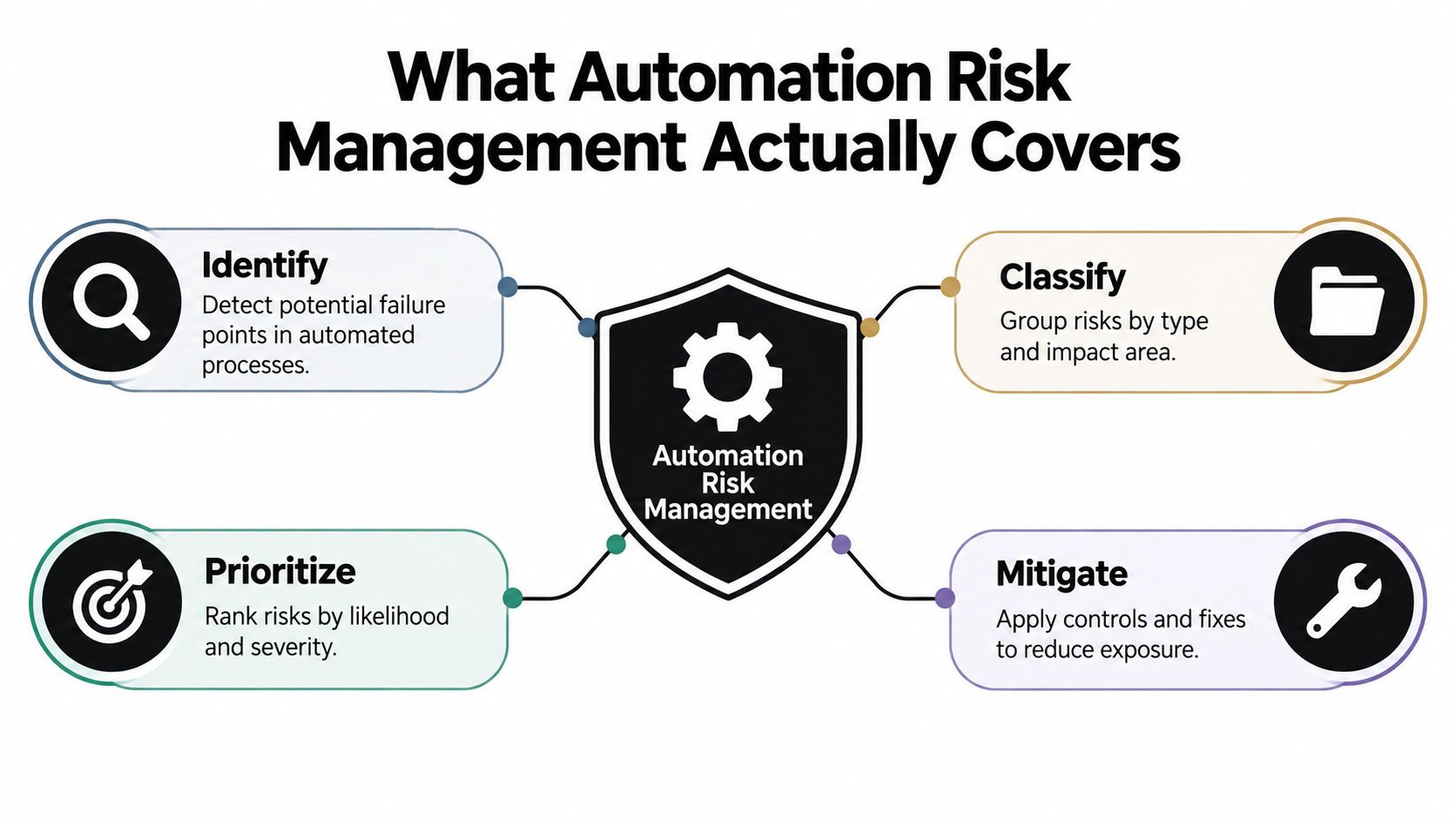
In plain terms, automation risk management is the ongoing practice of finding, classifying, prioritizing, and reducing the ways automated workflows can fail once software, AI, and integrations are making decisions inside live operations.
That scope is wider than model performance. It includes triggers, payloads, transformation logic, approvals, fallbacks, retries, vendor dependencies, and every downstream side effect. If an AI agent drafts a decision and another service acts on it, both the judgment layer and the orchestration layer belong in the same risk conversation.
Start with probability and consequence
The cleanest way to think about automation risk is the same way mature risk programs frame other operational failures. Risk is the combination of probability and consequence. NIST's AI Risk Management Framework defines risk in exactly that way and organizes response around govern, map, measure, and manage in AI RMF 1.0.
That framing forces better questions:
- Probability: How likely is this workflow to misbehave given vendor changes, prompt drift, authentication expiry, or changing input patterns?
- Consequence: If it misbehaves, what gets damaged? Customer experience, approvals, regulated decisions, internal reporting, or sensitive data handling?
- Recoverability: Can the team reverse the error quickly, or does the automation create hard-to-untangle side effects across systems?
Use the NIST functions as the operating spine
For custom software teams, the NIST structure is useful because it's operational, not abstract. NIST released the framework for voluntary use on January 26, 2023 and designed it for organizations that design, develop, deploy, or use AI systems in order to improve trustworthiness, as described in the NIST AI RMF publication.
A practical adaptation looks like this:
Govern
Assign decision rights. Every automation needs a named owner, an approver for threshold changes, and a clear escalation path. Shared ownership usually means no ownership.
Map
Create an inventory of automations, triggers, upstream dependencies, downstream consumers, and failure consequences. Include where AI is used for classification, summarization, routing, or decision support.
Measure
Define the signals that prove the workflow is healthy. That might include expected event counts, payload validity, output variance, review outcomes, latency bands, and downstream completion events.
Manage
Apply controls, respond to incidents, pause unsafe behavior, and learn from failures. Rollback plans, exception queues, and post-incident updates all belong here.
Good automation risk management doesn't ask only whether the model answered correctly. It asks whether the business process remained trustworthy after the answer moved through real systems.
NIST's companion generative AI profile also matters here because it ties generative AI risk management back to the same voluntary framework for LLM integrations, AI agents, and decision-support features in NIST AI 600-1.
The Risk Categories That Hit Operations Teams Hardest
A workflow can look clean on the dashboard and still be damaging records, skipping cases, or pushing bad decisions into three other systems before anyone notices. That is the pattern operations teams deal with. The problem is usually not a single bad model output. It is weak visibility across chained automations and no clear rule for who stops the line.
Omission errors
Omission errors are the failures teams miss for the longest time. The automation should act and does nothing. A qualified lead never gets scored. A contract intake job ignores a supported attachment. A priority case never enters the escalation queue after an upstream field rename.
These failures are operationally expensive because absence is harder to detect than a wrong output. There is no obvious exception unless the team is watching expected volume, expected timing, and downstream completion events.
A systematic review published by the National Library of Medicine found strong evidence of automation bias across both omission and commission scenarios in human-automation studies, which helps explain why quiet systems are often trusted too quickly in production (systematic review on automation bias).
Commission errors
Commission errors are easier to see and often harder to contain. The workflow runs, but it takes the wrong action. It updates the wrong record, applies the wrong rule, fabricates a field value, or routes work to the wrong team.
LLM-backed workflows add a familiar production failure mode here. The output looks structurally valid, downstream logic accepts it, and the error becomes a process error instead of a model error. By the time someone catches it, the bad output may already have triggered notifications, approvals, billing changes, or case assignments.
Integration failures and cascading failures
Integration failures usually start as small contract mismatches at the edges. Credentials expire. A vendor changes an API response. Retries succeed with different semantics. A nullable field appears where downstream logic still assumes a value is always present.
What hurts operations is the chain reaction. One malformed output can create duplicate CRM records, suppress an invoice, misroute support work, and poison reporting in the same hour. Teams that govern each automation separately miss this because each local component still appears "up."
Industry reporting reflects the same pattern. The Airmic Risk Technology Survey Report describes persistent difficulty understanding AI limitations and turning deployments into measurable value. In operations, that usually points to weak cross-system controls and poor observability, not just bad model selection.
Overreliance
Overreliance shows up after a workflow has been correct often enough that people stop checking it. Reviewers approve too fast. Operations analysts stop reading exception notes. Sales or support teams trust a score or route they could not explain if asked.
This is a governance problem before it is a training problem. If no one owns threshold changes, review rules, and escalation criteria, human oversight degrades into a checkbox.
Research summarized in the automation bias review found that accountability improved verification behavior and reduced automation-related error. In practice, named approvers, visible audit logs, and required review on edge cases are controls that change behavior, not paperwork.
Risk categories and detection signals
| Risk Category | What Happens | Detection Signals |
|---|---|---|
| Omission errors | Valid inputs never trigger action or disappear mid-flow | Volume drops, missing downstream events, gaps between trigger and output logs |
| Commission errors | Workflow completes but writes wrong decisions or wrong records | Spike in corrections, repeated reviewer overrides, malformed or implausible outputs |
| Integration failures | Connected tools drift out of contract without full outage | Auth failures, schema mismatches, stale enrichment, retry storms |
| Overreliance | Humans approve outputs without meaningful verification | Near-zero review variance, very fast approvals, declining exception notes |
| Cascading failures | One bad output contaminates several downstream systems | Reconciliation deltas, duplicate records, conflicting state across tools |
Assessing and Prioritizing Automation Risk
Assess automation one workflow at a time, usually after something breaks. That's too late and too narrow. The useful unit of analysis is the portfolio. Once a company has multiple AI and software automations across revenue, service, finance, or operations, it needs a ranked view of exposure.
Build the inventory first
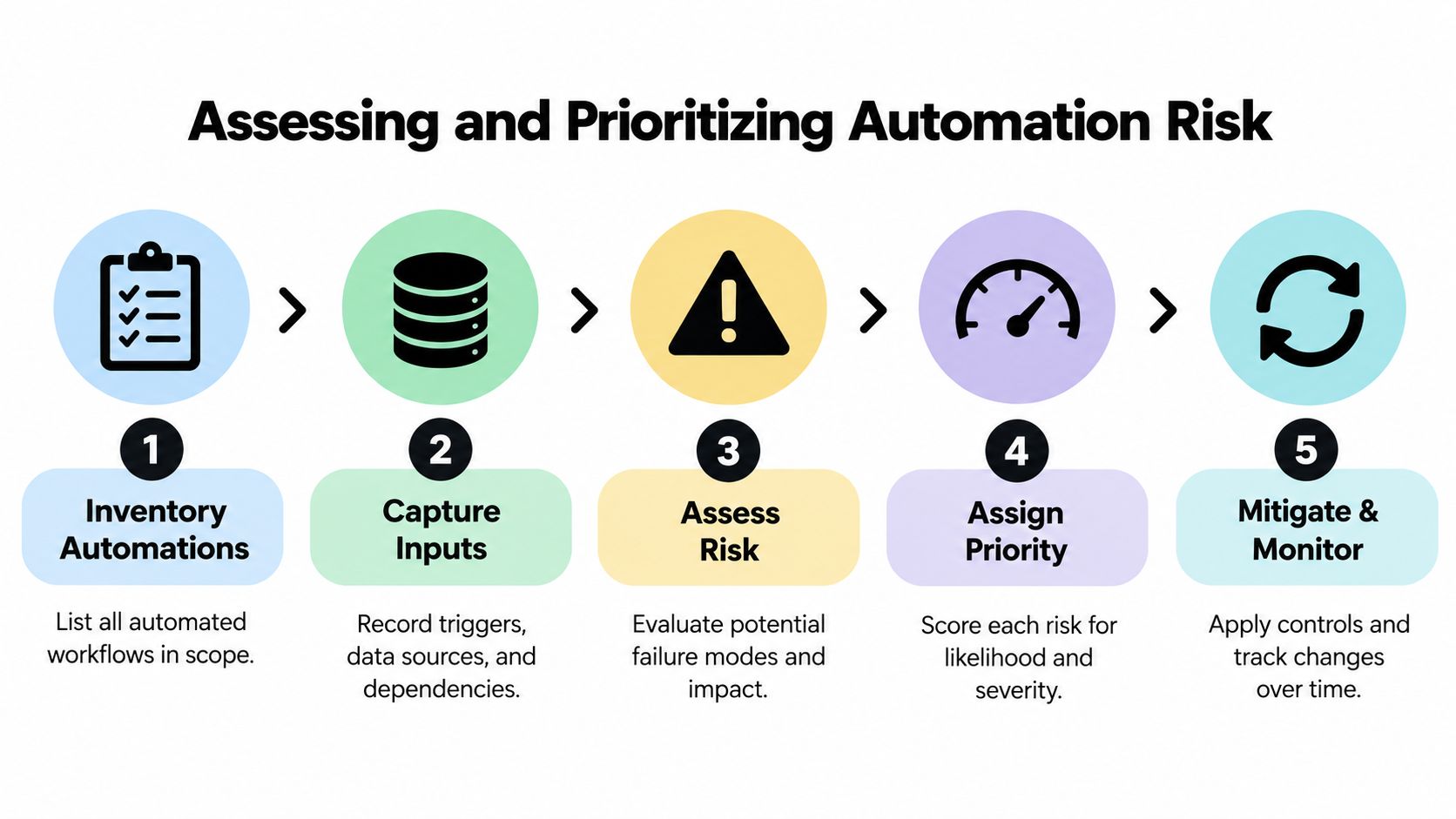
Start with every automation in scope. Include bespoke backend jobs, event-driven workflows, LLM routing layers, document classifiers, internal admin automations, and cross-system syncs. For each one, capture the essentials:
- Trigger and entry point: form submission, webhook, scheduled job, user action, model response
- Inputs and dependencies: APIs, uploaded files, internal services, external vendors
- Outputs and side effects: CRM updates, approval decisions, tickets, notifications, record creation
- Named owner: the person accountable for health, not just the engineer who built it
- Downstream consumers: teams and systems that act on the output
Without this inventory, teams can't reason about blast radius. They can only react locally.
Score by blast radius, not technical novelty
The next step is ranking. Some automations are technically complex but easy to reverse. Others are simple and dangerous because they write into customer-facing or financially material workflows.
A useful scoring approach weighs:
Likelihood of failure Consider dependency volatility, prompt churn, weak input validation, and poor observability.
Consequence severity Ask what happens if the automation is wrong for a day, a week, or a month.
Reversibility Can the team unwind the action, or has it already changed multiple systems and decisions?
Data sensitivity If the workflow touches sensitive customer or internal information, the control threshold should rise.
The assessment process is easier to operationalize when teams can see it in sequence.
Tie controls to the tier
Once ranked, apply controls unevenly. High-blast-radius automations deserve more friction. Low-risk ones don't.
Operator rule: Add human review where errors are hard to reverse, not where the model feels new or unfamiliar.
For high-tier workflows, use forced review, dual approval for threshold changes, and pause capability. For low-tier flows, standard logging, basic alerting, and periodic spot checks are usually enough.
Review the inventory on a fixed cadence. Also treat specific changes as automatic re-review triggers:
- Prompt or decision-logic updates
- Vendor API contract changes
- Schema migrations
- New downstream consumers
- Ownership changes
A 2025 SHRM analysis estimated that about 12.6% of current U.S. employment, or 19.2 million jobs, faces high or very high automation displacement risk, with overall exposure distributed across negligible, slight, moderate, high, and very high categories in SHRM's automation displacement risk analysis. For operators, the important lesson isn't just labor exposure. It's that automation risk is uneven, and prioritization has to be role, task, and workflow specific.
Practical Controls and Monitoring Patterns
Once the risk register exists, the question becomes simple. What controls change production outcomes? The answer is rarely “more AI.” It's usually stronger ownership, better auditability, cleaner exception handling, and cross-system observability.
Ownership and audit trails
Every automation needs a named human owner. Not a team alias. Not “Ops.” One person who knows what healthy behavior looks like, who receives alerts, and who can pause or reroute the workflow.
Logging also needs to be designed for the full chain. For each material automation, record:
- Input state: what entered the workflow and from where
- Decision state: what rules, thresholds, or model outputs were used
- Output state: what the automation wrote, sent, or approved
- Correlation context: a traceable identifier that links each step across services
- Fallback behavior: whether the workflow retried, defaulted, or moved to exception handling
In custom systems, this often means event logs in the application layer, not just vendor logs scattered across third-party dashboards. A practical example of this design pattern appears in an insurance operations dashboard project, where cross-step visibility is built into the operating surface rather than left hidden inside disconnected tools.
Forced review and exception paths
High-risk automations need deliberate friction. The usual patterns work well when teams implement them consistently:
| Risk Tier | Required Controls | Review Cadence | Monitoring Signals |
|---|---|---|---|
| Critical | Named owner, forced human review, dual approval for threshold changes, rollback procedure | Frequent operational review and formal scheduled review | Missing downstream events, anomalous outputs, failed reconciliations, exception backlog |
| High | Confidence thresholds, sampled review, contract tests, alerting on drift | Regular owner review | Volume drops, stale records, retry spikes, rising overrides |
| Moderate | Standard logging, threshold alerts, documented fallback behavior | Periodic review | Error trends, processing delays, repeated identical outputs |
| Low | Basic health checks and run logs | Lightweight review | Job failures, missed schedules, simple volume anomalies |
Some review patterns are especially effective:
- Confidence gating: Auto-act only above a defined threshold. Borderline cases go to a human queue.
- Dry-run mode: Let the automation produce a recommendation without executing downstream actions until output quality is proven.
- Sample review: Even stable workflows need periodic human sampling to catch drift and reviewer complacency.
Watch for silent degradation
The best alerts are not generic error counts. They're business-significant signals:
- Stale data: enrichment or source freshness drops below the expected window
- Repeated identical outputs: a classifier starts returning suspiciously uniform results
- Input drift: payload shapes or content distributions change materially
- Missing expected side effects: the lead was scored but never assigned, the summary was generated but no case was created
- Exception queue growth: a backlog forms because the team isn't resolving edge cases fast enough
Operations leaders should also pay attention to where automation pressure concentrates. OECD research found that construction and extraction, farming, fishing and forestry, production, and transport and material-moving occupations are among the highest-risk categories, together accounting for about 28% of employment across OECD countries, according to OECD automation risk research. The underlying principle applies broadly to software design: repetitive execution work needs tighter controls than planning and oversight work.
Two Founder-Led Examples Done Well and Done Poorly
The fastest way to understand automation risk management is to compare two implementations that looked efficient at launch and aged very differently in production.
Lead scoring with no confidence floor
The weak version is common in founder-led SaaS. Marketing captures inbound leads, an enrichment service appends firmographic data, an ML scoring layer ranks the lead, and the system routes directly into the CRM. Nobody wants sales slowed down, so every record gets auto-routed. No confidence threshold. No freshness check. No exception queue.
It works until upstream data quality shifts. Scores drift. Reps start chasing dead leads and stop trusting the routing logic. The founder sees lower conversion and asks for a model tweak, even though the operating issue is governance.
The stronger version adds a few controls before scale. A minimum data-freshness rule blocks stale enrichments. Low-confidence scores route to review instead of auto-assignment. One operations owner watches score distribution and override patterns. Borderline outputs land in an exception queue that someone clears. That setup is similar in spirit to this real estate lead automation example, where routing logic and operational review are designed together.
Cross-tool reconciliation without contract tests
The weak version of reconciliation assumes vendors will stay aligned. Stripe posts customer and payment events, HubSpot stores lifecycle data, and the warehouse becomes the reporting layer. Teams trust the sync because each platform remains individually healthy.
Then a schema change hits one integration path. Customer records duplicate, reporting logic drifts, and ARR views stop matching operational reality. Nobody can tell which system should be treated as authoritative because no rollback or reconciliation threshold was defined.
A reconciliation workflow is not low risk just because it doesn't look like AI. If it feeds decisions, forecasts, or downstream automation, it needs the same discipline.
The stronger version uses contract tests between systems, alerts on reconciliation deltas, and a documented rollback path when a mismatch crosses the accepted threshold. That's the pattern in both examples. The good version isn't “smarter.” It's easier to observe, pause, and correct.
Implementation, Handoff, and Independent Operation
A lot of risky automations aren't poorly built. They're poorly handed off. The build team ships the workflow, everyone celebrates the launch, and the operating team inherits something it can use but not safely govern.
Put risk reviews into delivery
Risk review belongs inside implementation, not after it. The useful checkpoints are straightforward:
- Pre-go-live review: confirm ownership, controls, rollback path, alert routing, and exception handling
- Stabilization window: watch the workflow closely after launch and tune thresholds while real inputs arrive
- Formal transition: move responsibility from build team to operating owner with explicit sign-off
NIST's AI RMF Core is designed to produce outcomes and actions that support dialogue and activities for managing AI risk responsibly through govern, map, measure, and manage, as outlined in the AI RMF Core resource. That's useful here because handoff is not just documentation. It's the moment those four functions become someone's day-to-day job.
Hand over the artifacts people actually need
Operators don't need a polished architecture deck alone. They need tools for running the system without the original builders. At minimum, handoff should include:
- Runbook: normal operating flow, known failure modes, pause procedure, and break-glass actions
- Risk register excerpt: the specific ranked risks for that automation and the controls attached to each
- Decision-rights matrix: who can change prompts, thresholds, approval logic, or routing behavior
- Metrics sheet: what each alert means, who gets it, and how quickly it must be handled
If a client team is evaluating whether to build internal tooling or rely on packaged AI features, that decision affects how much of this governance they can own directly. A practical comparison is outlined in build vs buy AI tooling.
Independence is the real success metric
The handoff is complete when the operating team can detect, triage, and adjust the automation without returning to the builders for every change. That means they can answer basic but critical questions on their own:
- What failed
- When it started
- Which records were affected
- Whether the workflow should be paused
- Who is authorized to change thresholds or rollback logic
The readiness signals are concrete. A signed acceptance checklist. A live dashboard the owner uses. A named escalation channel. A quarterly risk review already on the calendar.
Organizations building AI-enabled internal workflows also benefit from the fact that the AI RMF itself was developed through a consensus-driven, open, and transparent process with public comment and workshops, as described by NIST's AI Risk Management Framework program page. That makes it a practical reference point for custom software teams because it starts with governance and evaluation early, instead of treating them as cleanup work after deployment.
Internal Systems designs and builds custom software and AI-enabled workflows for operations teams that need automations to be reliable after launch, not just impressive in a demo. If you're dealing with chained tools, silent failures, or unclear ownership in live workflows, visit Internal Systems to see how those systems can be diagnosed, built, and handed off for independent operation.